- 01Seed recipe-demo creators, not just reviewers
- 02List where the sale already happens, not just where the audience is
- 03Turn a retail or milestone win into its own landing page and hashtag
- 04Install a plug-in affiliate program before building one custom
01 Snapshot
The one-glance read on who they are and how they grow. Each point is verifiable from the receipts above.
Compressed Mexican seasoning "bombs" (birria, pozole, tinga) for home cooking, sold direct, on Amazon and TikTok Shop, and now in 600+ Walmart doors after a home-kitchen start.
Creator-led, powered by a wide bench of TikTok and Instagram creators and a TikTok Shop storefront rather than brand-run paid social.
114,509 Instagram followers, ~25,500 monthly site visits (+9.8% over the trailing 3 months), and 16 Google ads (9 active as of 2026-07-15, oldest 242 days) sit alongside a reported $20M in full-year-2024 revenue, the most recent public figure.
As of 2026-07-15, three Google search ads first shown between 2026-07-01 and 2026-07-07 run alongside campaigns active 200+ days.
Their most-amplified placement by engagement isn't an ad or the .com, it's a creator's own TikTok Shop listing, which turns individual sellers into a distributed storefront network.
02 How it unfolded
The order the channels came online. Sequence is strategy: what they did first, and what they layered on once demand existed.
03 Traffic & channel mix
Estimated demand, the channel split behind it, and the keywords and referrers doing the work. Directional modeling, not audited analytics.
Traffic sources
Top search keywords
| Keyword | Volume | Weight | CPC |
|---|---|---|---|
| ez bombs | 2.1k | $0.50 | |
| birria bombs | 1.6k | $0.51 | |
| birria bomb | 2.4k | $0.49 | |
| birria bomb recipe | 690 | $0.29 | |
| birra bomb | 1.6k | $0.51 |
Closest competitors by audience
EZ Bombs pulls an estimated ~25,500 monthly visits, up +9.8% over the trailing 3 months. Referrals dominate the mix at 40.6%, well ahead of organic search (24.1%) and direct (16.2%), with paid search adding another 13.3%; the rest, email, display, and paid or organic social, totals under 6%. That referral-heavy split lines up with a brand whose site links out to a customer-referral program and whose creators sell directly through TikTok Shop rather than always routing to ezbombs.com, so a large share of "referral" traffic is plausibly affiliate and shop-link driven rather than classic backlinks. The paid-search share tracks directly to the Google Ads campaigns broken down below. On keywords, "birria bomb" pulls roughly 2,400 searches a month and "ez bombs" about 2,100, meaning the category term now draws nearly as much demand as the brand name itself, a sign the product name is becoming generic shorthand for the format. Among competitors, flavourbombs.com is a near-identical "bomb"-format copycat; spiceorbs.com targets the same easy-prep spice-pod angle; and vvng.com, which also shows up in the competitor set, is actually Victor Valley News, the local paper that has covered the founder's story, not a rival product.
04 Organic content
The specific pages earning their organic search traffic, and the pattern behind why they rank. Adapt the format, not the topic.
Their top organic pages are all product pages titled like recipe content: "Birria Bombs, Birria Recipes Made Easy" and "Pozole Bomb Pack, Traditional Pozole Recipes Made Easy" carry the bulk of the traffic among their five ranked pages, with the homepage, the products index, and a single blog recipe post filling out the rest. The pattern is a commercial page dressed as a how-to: instead of separating SEO content from product listings, each flavor's product page owns the recipe-intent keyword outright, which is why it ranks #1 for "pozole bombs," "pozole bomb," and "ez bombs," and #2 for "birria bombs." That merges the shopper and the recipe-searcher into the same landing page rather than splitting them across a blog and a store.
Top pages by organic traffic
05 Channel map
Not traffic share. How much weight the growth system actually puts on each channel, with a one-line read on the role it plays.
What drove growth
06 The creative doing the work
Each exhibit shows the actual asset, an X-ray of why it works, a status, and a play you can adapt. This is the heart of the teardown.
Google Ads carries EZ Bombs' entire visible paid footprint: 16 total ads as of 2026-07-15, 9 still active, with the oldest active ad running 242 days, a genuine longevity signal for a young CPG brand rather than a rebrand-era test wave. Three deep dives from that proven-winner pool:
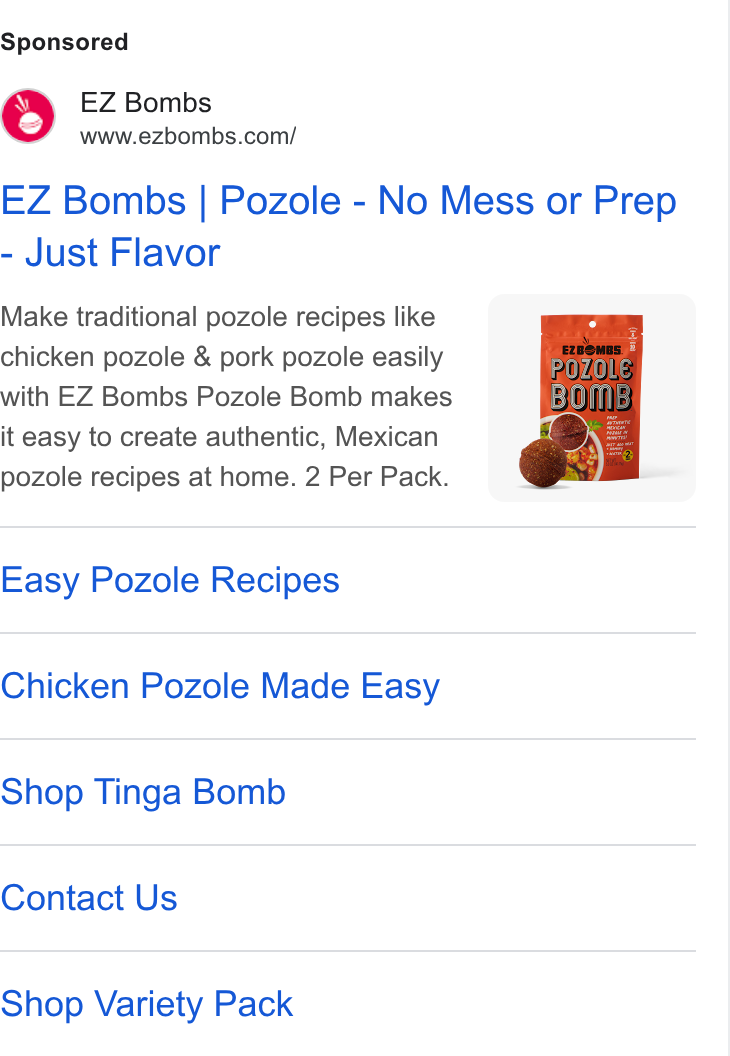
- Hook: "EZ Bombs | Pozole - No Mess or Prep - Just Flavor." Why it works: It leads with the single biggest objection to cooking Mexican dishes at home, hours of prep and cleanup, and kills it in the headline before the click even happens. Run this play: Expanded as Play 5 below.
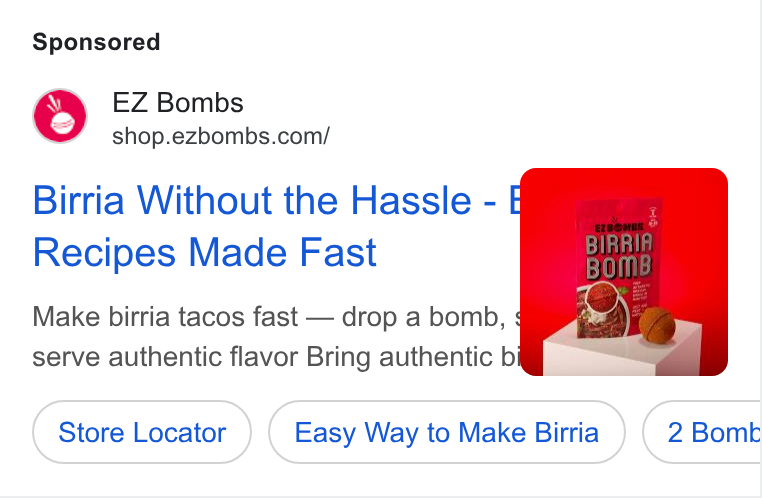
- Hook: "Birria Without the Hassle - Recipes Made Fast," paired with a product shot of the red "BIRRIA BOMB" pouch. Why it works: The problem-agitation headline and the literal product reveal land in the same frame, so the ad doubles as an unboxing. Run this play: Expanded as Play 5 below.
- Hook: "Authentic Tinga Flavor - Tinga Recipes Made EZ." Why it works: It captures searchers who are already recipe-hunting for a specific dish and converts that informational intent straight into a product click. Run this play: Expanded as Play 5 below.
Against that veteran pool, three fresh text ads (first shown 2026-07-01 through 2026-07-07) mark the current test wave running in parallel with the 200-day-plus campaigns above.
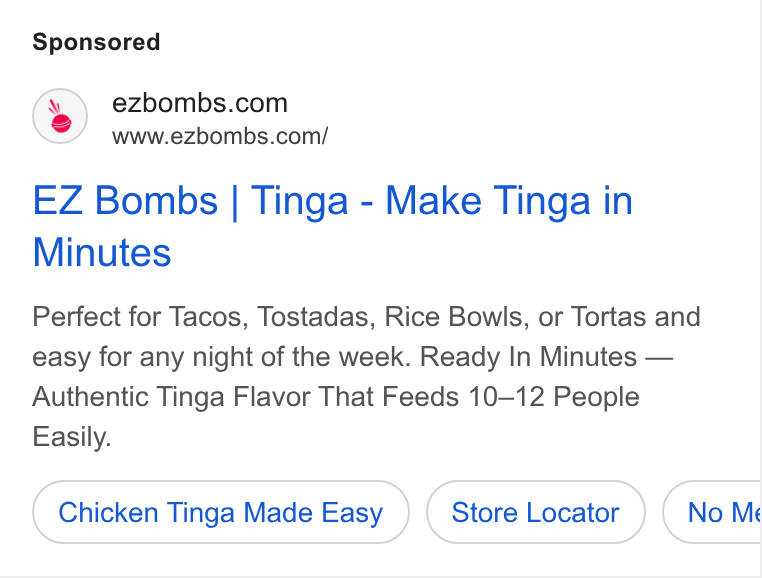
- Running
- 126 days (longevity = it's converting)
- Hook
- Sponsored ad with a small red icon, company name "ezbombs.com", and website "www.ezbombs.com/" followed by the headline "EZ Bombs | Tinga - Make Tinga in Minutes".
- CTA / offer
- Buttons for "Chicken Tinga Made Easy" and "Store Locator".
- Audience
- People looking for quick, easy, and authentic Mexican meal solutions, indicated by the product name "Tinga" and the description of its uses (Tacos, Tostadas, Rice Bowls, Tortas).
Why it works. A Google search ad that meets Tinga recipe searchers exactly where they are, converting recipe intent into a minutes-not-hours product promise.
Headline clearly states the product and its primary benefit: "EZ Bombs | Tinga - Make Tinga in Minutes". Pick your single most-searched use case, put its name plus a specific time claim in the first words of your headline.
- Running
- 52 days (longevity = it's converting)
- Hook
- Sponsored EZ Bombs www.ezbombs.com/ EZ Bombs | Pozole - No Mess or Prep - Just Flavor
- CTA / offer
- Shop Variety Pack
- Audience
- Individuals interested in Mexican cuisine, specifically pozole, who are looking for quick and easy meal solutions. This is signaled by the direct mention of 'traditional pozole recipes' and the promise of 'No Mess or Prep'.
Why it works. Speaks to Pozole searchers who already know the dish means hours of prep, and names that exact pain (mess, prep) before the payoff.
Headline with clear benefit proposition: 'EZ Bombs | Pozole - No Mess or Prep - Just Flavor' List the two specific hassles your product removes by name, then the payoff: No [pain 1] or [pain 2], Just [benefit].
- Running
- 15 days (longevity = it's converting)
- Hook
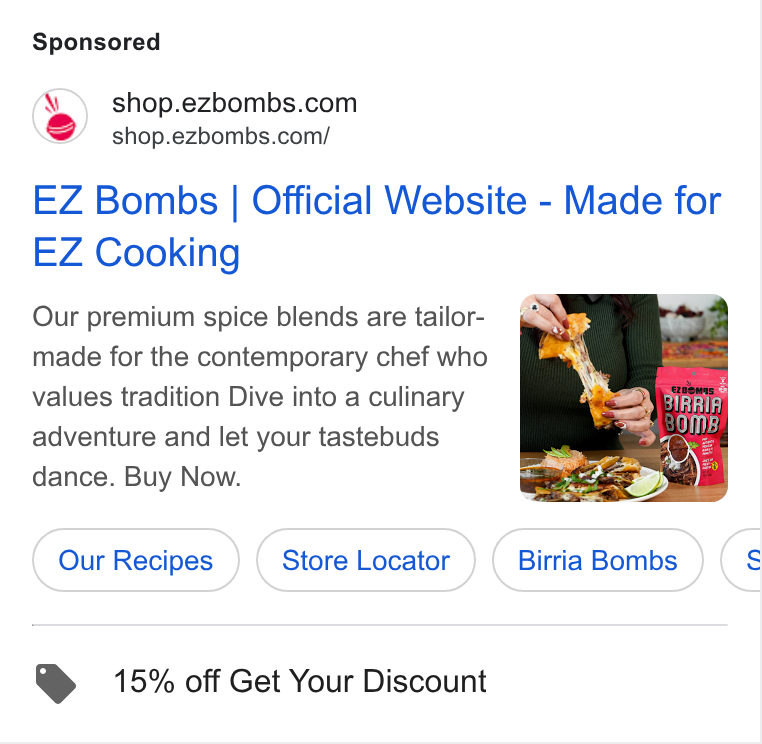
- Sponsored shop.ezbombs.com shop.ezbombs.com/ EZ Bombs | Official Website - Made for EZ Cooking
- CTA / offer
- 15% off Get Your Discount
- Audience
- The phrase "contemporary chef who values tradition" and the mention of "culinary adventure" targets home cooks interested in easy yet authentic flavor, as well as those looking to explore new cuisines.
Why it works. A branded search ad that reassures people who typed the brand name they found the real site, while restating that EZ is the whole product promise.
Headline clearly states product benefit and brand: "EZ Bombs | Official Website - Made for EZ Cooking" Run a search ad on your own brand name so competitors can't intercept it, and use the ad space to restate your core benefit, not just say hello.
Show 6 more exhibits
- Running
- 242 days (longevity = it's converting)
- Hook
- Sponsored text at the top, followed by the EZ Bombs logo and website, then the headline "Birria Without the Hassle - B Recipes Made Fast".
- Audience
- Individuals who enjoy birria but are deterred by the traditional preparation time, indicated by "Birria Without the Hassle" and "Recipes Made Fast".
Why it works. Targets birria searchers who already know the dish is a labor-intensive braise, and names that reputation directly before promising speed.
Headline directly addresses a pain point: "Birria Without the Hassle - B Recipes Made Fast". If your product shortcuts a task known for being slow or labor-intensive, name that reputation in the headline before your speed claim.
- Running
- 240 days (longevity = it's converting)
- Hook
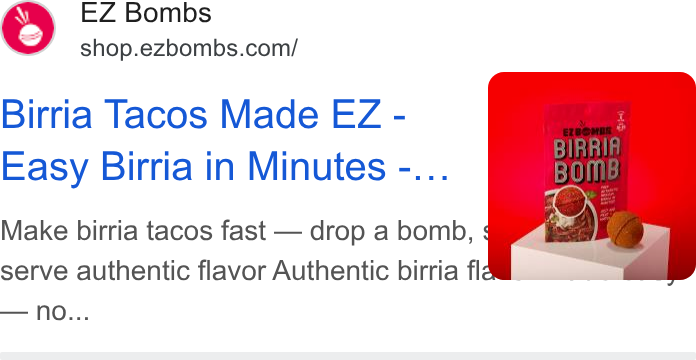
- EZ Bombs shop.ezbombs.com/ Birria Tacos Made EZ - Easy Birria in Minutes -... Make birria tacos fast - drop a bomb, s serve authentic flavor Authentic birria fla no... (visual: EZ Bombs logo, website, headline, and product image of a red pouch labeled "BIRRIA BOMB" next to a small, round, brown object on a white pedestal against a red background)
- Audience
- People who enjoy birria tacos but want a fast and easy way to prepare them, indicated by phrases like "Made EZ" and "in Minutes."
Why it works. A display ad pairing the actual Birria Bomb pouch with the finished taco dish, so a birria taco searcher sees literally what's in the package.
Prominent headline stating a clear benefit: "Birria Tacos Made EZ - Easy Birria in Minutes -..." Show your product's actual packaging next to the finished result it produces so browsers see exactly what they're buying before they click.
- Running
- 61 days (longevity = it's converting)
- Hook
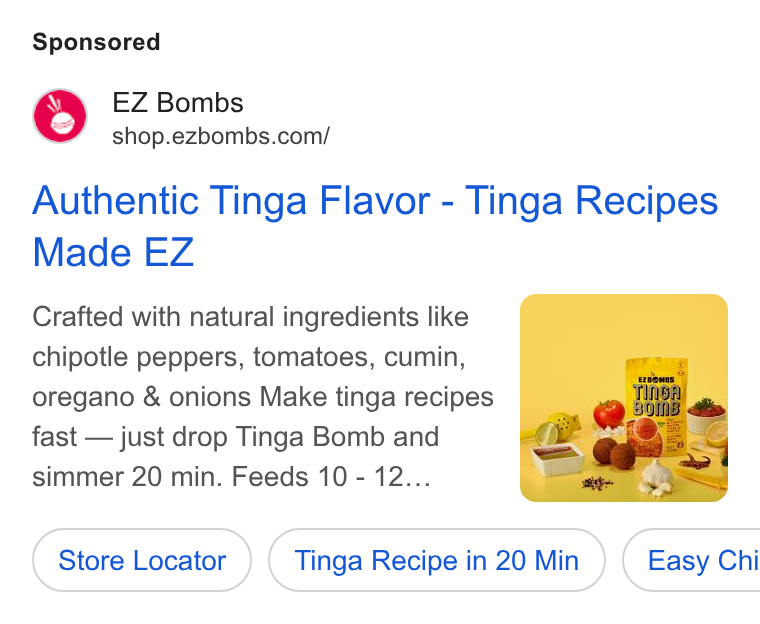
- "Sponsored" text at the top, followed by the EZ Bombs logo and website, then the headline "Authentic Tinga Flavor - Tinga Recipes Made EZ".
- Audience
- Home cooks looking for quick and easy meal solutions, indicated by "Made EZ" and "Make tinga recipes fast - just drop Tinga Bomb and simmer 20 min."
Why it works. Targets home cooks searching Tinga recipes who worry a packaged seasoning won't taste authentic, and answers that objection in the headline itself.
Headline emphasizing ease and authenticity: "Authentic Tinga Flavor - Tinga Recipes Made EZ" If your product is a shortcut, put your authenticity claim and your ease claim in the same headline so convenience doesn't read as lower quality.
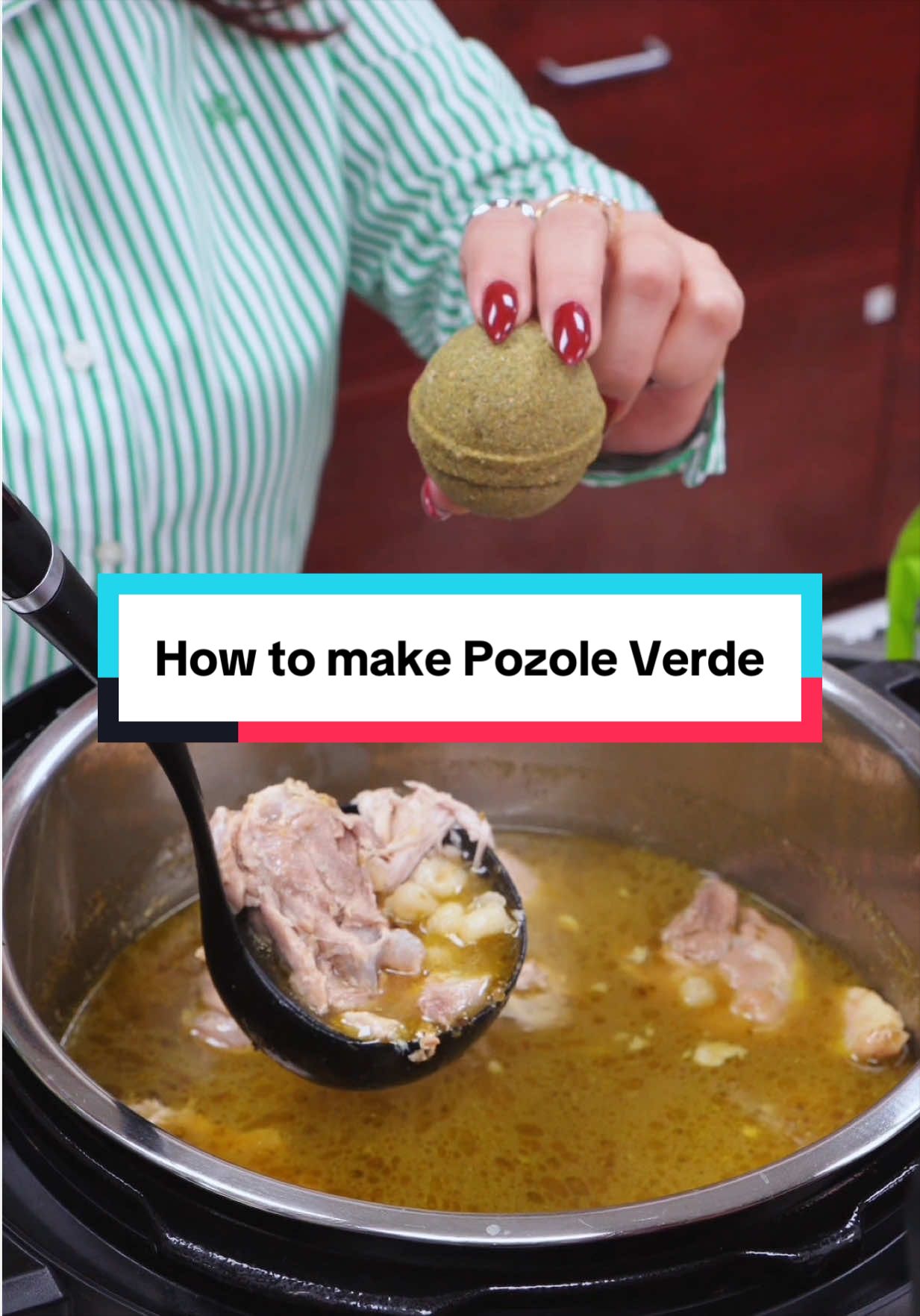
Who amplifies them
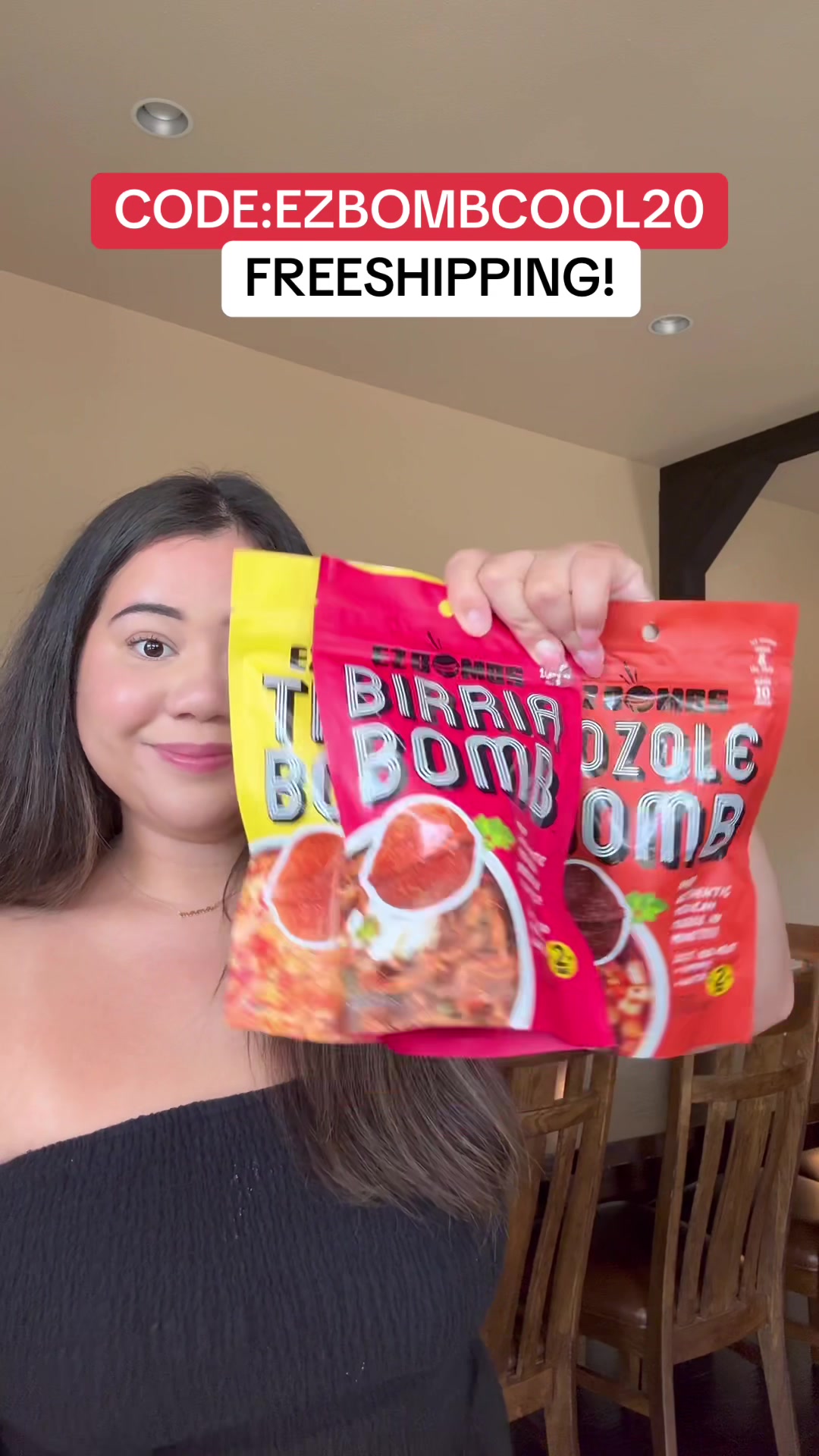
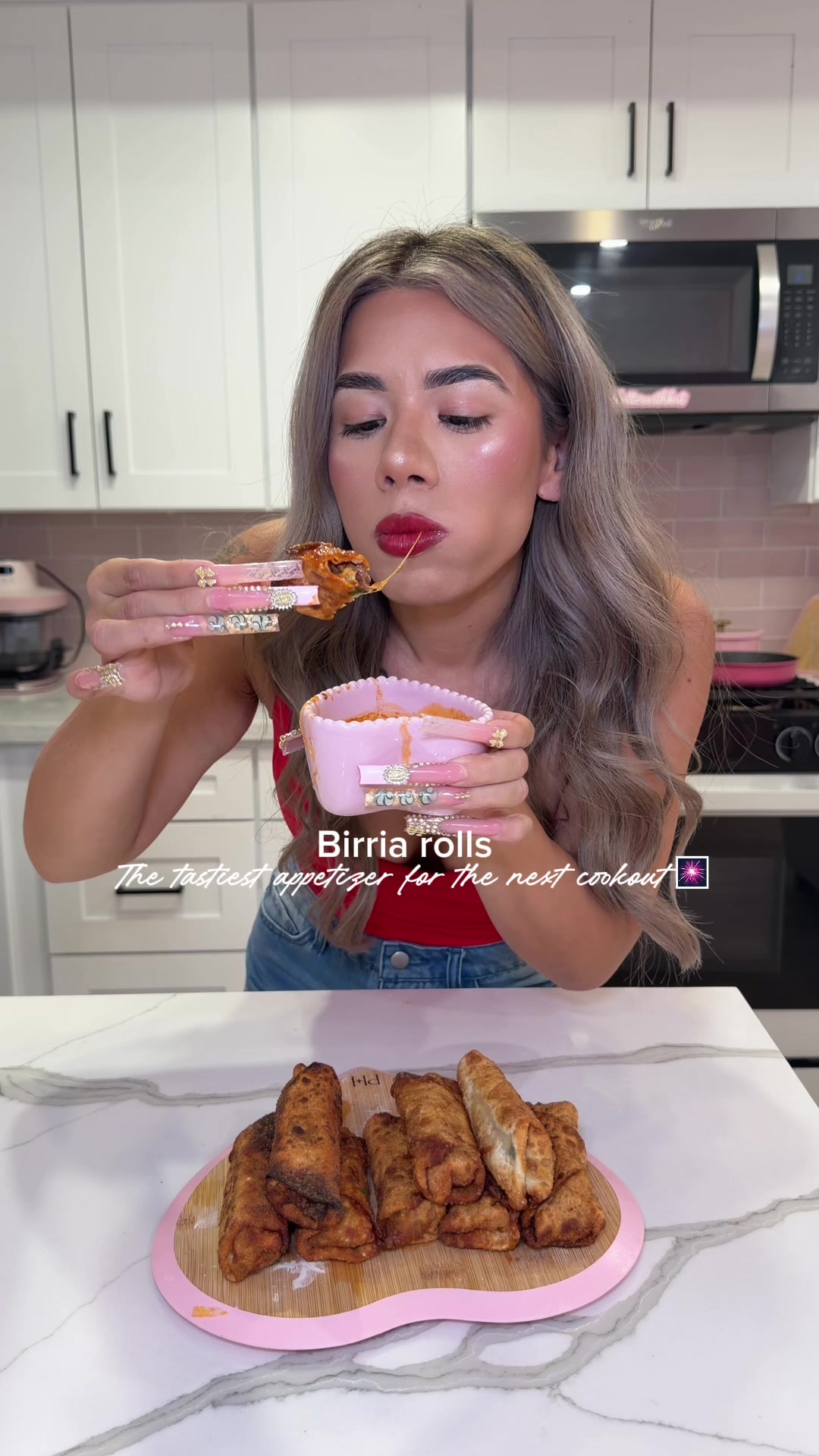
The brand account (@ezbombsfood) posts product-origin and behind-the-scenes content, distinct from the much larger pool of third-party creators actually driving reach: @Serinahnicholle (the TikTok Shop seller covered above), @lostucanesdetijuana, @LifesbetterwithKAT, and a long tail including @jennthornton18, @Melanie.Elaine, and Jasmin Meza posting unpaid taste-test and dinner-idea clips. A notable retail-launch moment shows up on Instagram: @itssaiylamoon posted "EZ Bombs is now at Walmart!" tagged #EZBombsInTheWild and #EZBombsWalmart, pointing followers to a dedicated ezbombs.com/walmart signup page, while @gunnsgirls' Fourth-of-July recipe post carries an explicit "[ad]" disclosure, showing the brand also runs paid creator partnerships alongside the organic UGC wave.
07 Organic & video
The organic content engine: the videos, creator posts, and community presence earning attention without paid spend.
Posting cadence leans on recipe-demo and seasonal-drop formats. @Serinahnicholle's TikTok Shop listing for the "BirriaBomb, PozoleBomb, TingaBomb Variety Pack" is the standout at 1,140,954 engagements, a sign creators are selling the product directly rather than just reviewing it. @LifesbetterwithKAT's Fourth-of-July "star bomb" post ("What are you taking the cookout?") pulled 22,279 engagements, and @lostucanesdetijuana's "How to make Pozole Verde using EZ Bombs!" tutorial logged ~13,500, plus the brand's own behind-the-scenes clip introducing founder Tina Castaneda (5,121 engagements) and a dozen smaller creator posts in the 22-2,900 engagement range. The format that wins is clear: demo-and-recipe clips ("how to make X using EZ Bombs") and limited-edition seasonal drops outperform straight product reviews.
08 Affiliate & partners
How the brand turns creators and partners into a tracked, variable-cost acquisition channel, and how the program is structured.
The site links to a Shopify-based affiliate and customer-referral program (a Secomapp referral app integration), recruiting referrers directly from the storefront. Layered on top of that is the TikTok Shop seller network itself, where creators like @Serinahnicholle list and sell EZ Bombs natively rather than driving traffic back to ezbombs.com, effectively functioning as a distributed, commission-based sales force.
09 The playbook
The channels are not separate. They are one system where each stage feeds the next. Here is the read, then the plays to run tomorrow.
The inferred playbook
EZ Bombs' loop starts with short recipe-solution clips from a wide creator bench, converts inside TikTok Shop and Amazon where the actual purchase happens, and compounds through recipe-titled product pages and branded search ads that defend the demand those creators create.
Dozens of small food and lifestyle creators post "how to make X using EZ Bombs" demos, with a March 2026 LinkedIn company post crediting TikTok Shop alone with $19M in cumulative revenue, a figure scoped to that one channel, not total company revenue.
The recipe-titled product pages covered above do double duty as SEO content and checkout pages, letting one URL capture both the recipe-searcher and the buyer.
Dig deeper+3▾
Public retail listings show 2-packs at $19.99 (often discounted to ~$16.99) and a 4-bomb bundle box at $34.99 with a recipe guide, an impulse-friendly price point suited to both retail shelves and TikTok Shop carts.
~25,500 monthly visits on ezbombs.com looks small next to a brand in 600+ Walmart doors, confirming most volume moves through Amazon, Walmart, and TikTok Shop rather than the owned site, consistent with the referral-heavy channel mix above.
The Amazon-versus-TikTok-Shop revenue split, retail sell-through per Walmart door, and the commission structure behind the on-site affiliate program.
Seed recipe-demo creators, not just reviewers
The proofEZ Bombs' highest-performing organic clips are "how to make X using EZ Bombs" demos from creators like @lostucanesdetijuana (~13,500 engagements), not straight product reviews.
The adaptationStart by shipping product to five to ten micro creators in your category with one specific brief, show the raw-to-finished result in a single continuous demo cut, not a talking-head review, mirroring the pozole-verde tutorial's structure. Track which dish or use case each creator's demo unlocks, then repeat the brief with the ones that land.
Cost: under $500 · Time to signal: weeks · Works pre-PMF: yes
List where the sale already happens, not just where the audience is
The proof@Serinahnicholle's own TikTok Shop listing for EZ Bombs' variety pack outperformed every other single piece of content in the evidence, at over 1.1 million engagements.
The adaptationIf your product can ship through a platform's native shop feature, list it there with an affiliate commission enabled, then recruit sellers who already post in your niche to build their own listing rather than just tagging your brand account. The mechanism: giving a creator their own storefront, not just a discount code, turns them into a distribution node instead of a one-off endorsement.
Cost: $0 · Time to signal: weeks · Works pre-PMF: conditional, needs a physical product that can ship through the platform's native commerce and shop-level fulfillment.
Turn a retail or milestone win into its own landing page and hashtag
The proofWhen EZ Bombs landed Walmart shelf space, creators like @itssaiylamoon posted under #EZBombsInTheWild and #EZBombsWalmart, pointing to a dedicated ezbombs.com/walmart signup page rather than the homepage.
The adaptationThe next time you hit a real distribution milestone (a new retailer, a marketplace listing, a city launch), build a one-page landing page for that specific event with its own signup capture, and hand two or three creators a simple prompt to film themselves finding it "in the wild." The single-purpose URL is what makes the moment trackable and shareable, not just announceable.
Cost: under $500 · Time to signal: days · Works pre-PMF: conditional, needs an actual distribution or launch milestone to hang the moment on.
Install a plug-in affiliate program before building one custom
The proofEZ Bombs runs its referral motion through an off-the-shelf Shopify affiliate app rather than a custom-built program.
The adaptationFirst step: install a low-cost affiliate or referral plugin on your existing storefront, set a flat commission and discount code, and email it to your last 50 to 100 customers as your first affiliate cohort before recruiting anyone new. The plugin does the tracking and payout work that would otherwise take a developer sprint to build.
Cost: under $500 · Time to signal: weeks · Works pre-PMF: yes
Buy the category term once organic demand for it exists
The proofEZ Bombs' longest-running Google ad has stayed active 242 days as of 2026-07-15, bidding on category terms it shares with a copycat competitor, flavourbombs.com, covered above.
The adaptationOnce your own product name or category term starts pulling real organic search volume, run a small budget of exact-match search ads on that exact term with a bold, objection-killing headline claim, the no-mess, no-prep style claim EZ Bombs leans on, so a copycat can't buy the click first. This only makes sense after the organic demand exists; buying a term nobody searches yet just burns budget.
Cost: under $500 · Time to signal: days · Works pre-PMF: conditional, only pays off once there is measurable search volume for your product or category term. Not transferable at an earlier stage: the Walmart-scale retail motion and a 242-day paid-search budget both assume distribution and cash flow most pre-PMF founders don't have yet; adapt the seeding and landing-page mechanics above well before attempting either.
You just read how EZ Bombs does it. Tomorrow it is someone else.
Every morning we take one company that is actually growing and break down where its customers come from: the ads still running after a year, the channel doing the real work, and the play you can run this week.
Systemaic · directional intelligence. Traffic, spend, and reach figures are SimilarWeb-style estimates and qualitative reads of public data, not audited numbers. Built on real public receipts.
// teardowns with a similar GTM motion
sources & receipts (1)
Live ad libraries: google ad library
Traffic, spend, and revenue figures are estimates as noted in the report; the links above are the primary public artifacts.