- 01Cliffhanger-clip funnel
- 02Localize the house account
- 03Recycle organic hooks into paid creative
- 04Ship a dedicated ad-landing domain
01 Snapshot
The one-glance read on who they are and how they grow. Each point is verifiable from the receipts above.
A short-form vertical "microdrama" streaming app (30-60 second serialized episodes) monetized via ads, coin purchases, and subscriptions.
Paid-led and creator-seeded, run through an owned content factory rather than a founder's personal audience.
~3,487,811 estimated monthly visits (+57% over the trailing three months) as of July 28, 2026; 76 total Google ads with 65 active as of the same date; Q1 2025 in-app revenue of $120M (+29% YoY).
Google ad tests launched between June 5 and July 24, 2026 push curiosity hooks like "Discover trending content" alongside the standing "watch for free" claim, per the July 28, 2026 ad-library snapshot.
The funnel is a two-track creative factory, cliffhanger clips that route to an in-app "search this code" unlock on one side, and a Google/LinkedIn text-ad fleet running through a dedicated ad-landing subdomain on the other, so the domain-level traffic numbers here undercount how much of the real acquisition volume is paid.
02 How it unfolded
The order the channels came online. Sequence is strategy: what they did first, and what they layered on once demand existed.
03 Traffic & channel mix
Estimated demand, the channel split behind it, and the keywords and referrers doing the work. Directional modeling, not audited analytics.
DramaBox pulls an estimated 3,487,811 monthly visits across all channels, up +57% over the trailing three months as of the July 28, 2026 snapshot. No further channel-by-channel breakdown, ranked keywords, or named referrers and competitors were captured in this pull, so the channel-mix read leans on the owned and paid evidence detailed below instead.
04 Channel map
Not traffic share. How much weight the growth system actually puts on each channel, with a one-line read on the role it plays.
What drove growth
05 The motions doing the work
For founder-led SaaS the breakdown shifts from ads to traction: where the first users came from, how the founder grows it in the open, and the compounding organic surface.
DramaBox's traction curve reads as a paid-acquisition ramp rather than a single launch spike.
The app went live in April 2023, and the evidence shows no Product Hunt debut, no genuine Hacker News submission, and no dated Reddit launch post, consistent with a China-based studio going straight to paid mobile acquisition instead of a developer-community launch.
Revenue grew from roughly $8M in 2023 to about $323M in full-year 2024, and Q1 2025 in-app revenue hit $120M (+29% YoY), pushing cumulative in-app revenue past $450M by March 2025; the public data does not break out how much of that jump came from paid spend versus organic pickup.
Dig deeper+1▾
The clearest evidence of how most users actually encountered the app is downstream reaction, not a launch thread: the r/OutOfTheLoop post from October 2024 that racked up 342 upvotes was users asking about the ads themselves, not organic discovery of the product.
DramaBox's public-facing growth runs through owned brand channels, not a founder's personal audience.
Chairman Chen Ruiqing, who leads parent company Beijing Dianzhong Technology, has no verified personal X, LinkedIn, or Instagram presence in the evidence, so the founder build-in-public motion common to indie software companies is simply absent here.
The owned YouTube channel dramaboxapp, posting near-daily full episodes, functions as the brand's real public face in place of a personal one.
Dig deeper+1▾
The TikTok house presence splits by market, with "DramaBox- drama pendek" (pendek means "short" in Indonesian) targeting Southeast Asia while dramabox_official runs the English-led Instagram, showing a market-segmented content operation rather than a single voice.
The real compounding asset is the owned YouTube library, with paid search layered on top of it rather than replacing it.
Near-daily uploads of full episodes titled as searchable hooks (for example the 81,329-view "Sold By My Dad, Kidnapped On My Wedding Day") work like programmatic SEO for YouTube search and suggested placement, testing which hook phrasing pulls views before it gets reused elsewhere.
The same curiosity and bold-claim phrasing ("Discover trending content," "Watch for free") recurs across YouTube titles, creator captions, and the Google ad-creative set, suggesting phrasing that proves out organically gets promoted into paid tests.
Dig deeper+2▾
Every Google ad creative displays "gg.dramabox.com" rather than the main dramabox.com domain, a dedicated subdomain that most likely lets DramaBox isolate paid-campaign traffic from organic for cleaner measurement. The 76-ad Google fleet's proven-winner set is dominated by a near-identical text unit, "DramaBox gg.dramabox.com/ Watch now - Watch for free," a low-production direct-response line optimized purely for the free-content claim rather than a narrative hook; a smaller curiosity-hook variant ("Discover trending content" on a pink background) leans on FOMO instead. An April 2026 partnership with The Trade Desk, a programmatic ad-buying platform, per company PR, signals DramaBox professionalizing ad buying beyond the Google and LinkedIn fleets visible here.
Just 3 ads, all active for roughly 286 days, is too small and too long-running to be a consumer channel, reading instead as a low-intensity, always-on play aimed at talent or investors.
06 Paid ads
This founder-led SaaS also runs paid acquisition. Here are the live ads doing the work, each with the X-ray and a play you can adapt.
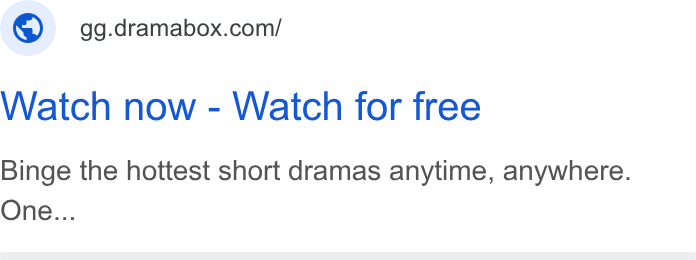
- Running
- 52 days (longevity = it's converting)
- Hook
- gg.dramabox.com/" + a globe icon, followed by "Watch now - Watch for free"
- CTA / offer
- Watch now - Watch for free
- Audience
- Individuals interested in short dramas and free streaming content, indicated by the text "Binge the hottest short dramas anytime, anywhere." and "Watch for free."
Why it works. Directly offer free access to short-form entertainment to acquire new users for a streaming platform.
Prominently display the core offer: "Watch now - Watch for free" as the main headline. Lead with your most compelling free offer or value proposition in large, clear text at the top of your ad creative.
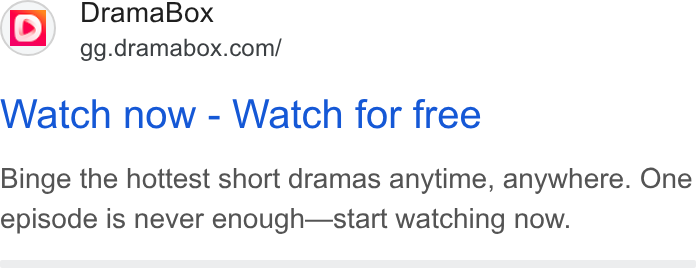
- Running
- 51 days (longevity = it's converting)
- Hook
- DramaBox gg.dramabox.com/ Watch now - Watch for free
- CTA / offer
- Watch now - Watch for free
- Audience
- Individuals interested in short-form video content, specifically 'short dramas', who are looking for free access, as indicated by 'Binge the hottest short dramas anytime, anywhere' and 'Watch for free'.
Why it works. This creative uses a direct response approach with a clear free offer to drive immediate user acquisition for its short-form drama platform.
Headline with a direct, no-cost offer: 'Watch now - Watch for free' Lead with your core value proposition and any free offer in the primary headline to immediately capture attention and signal benefit.
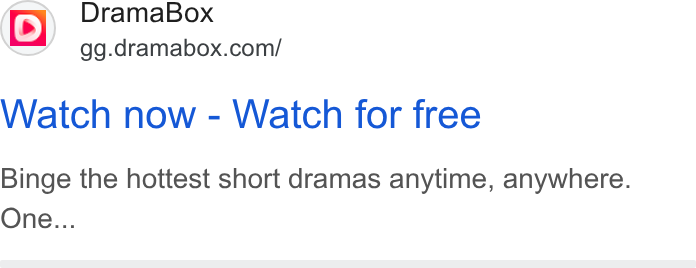
- Running
- 51 days (longevity = it's converting)
- Hook
- DramaBox gg.dramabox.com/ Watch now - Watch for free
- CTA / offer
- Watch now - Watch for free
- Audience
- Individuals interested in short-form drama content, indicated by 'Binge the hottest short dramas anytime, anywhere.'
Why it works. Direct response ad using a clear value proposition and a strong call to action to drive immediate clicks to a streaming platform.
Prominent display of 'Watch now - Watch for free' as the main headline. Make your primary offer (especially if free) the largest and most central text element in your ad creative.
Show 3 more ads
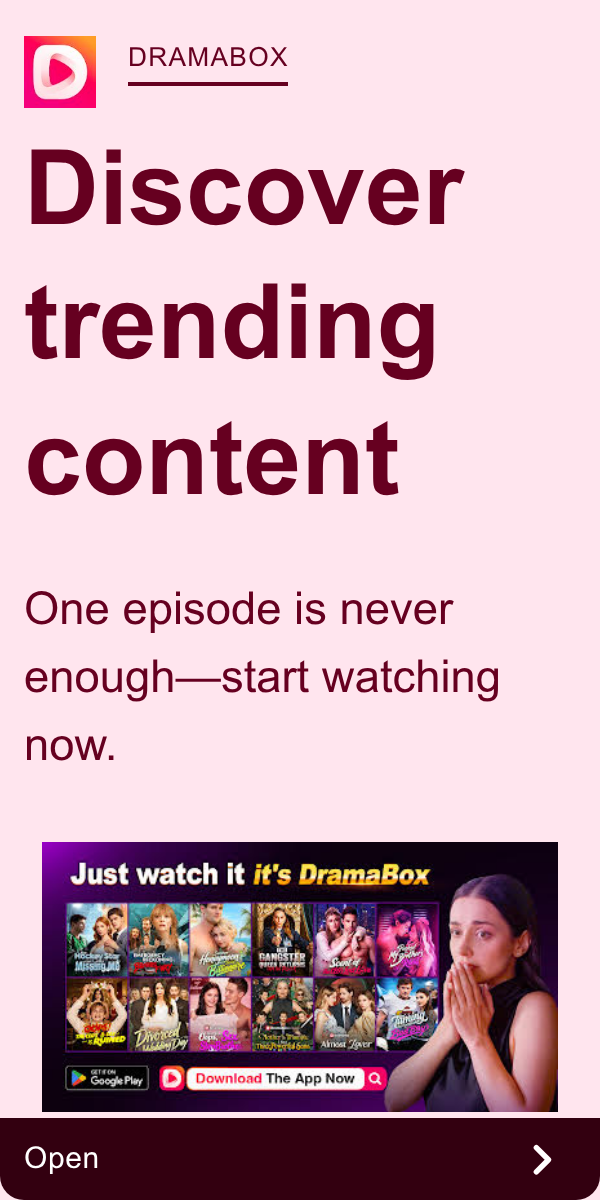
- Running
- 51 days (longevity = it's converting)
- Hook
- A pink background with a white play button icon in a pink square, next to the word "DRAMABOX" underlined. Below this, the large, dark red text "Discover trending content" is displayed.
- CTA / offer
- Download The App Now
- Audience
- The image shows a variety of drama series posters, indicating it targets viewers interested in dramatic storytelling and binge-watching content.
Why it works. To attract new users by highlighting the availability of trending content and encouraging immediate app download for continuous viewing.
Headline and sub-headline messaging: "Discover trending content" and "One episode is never enough—start watching now." Use a bold, benefit-driven headline that promises discovery of desirable content, followed by a sub-headline that emphasizes the addictive nature of your product.
- Running
- 50 days (longevity = it's converting)
- Hook
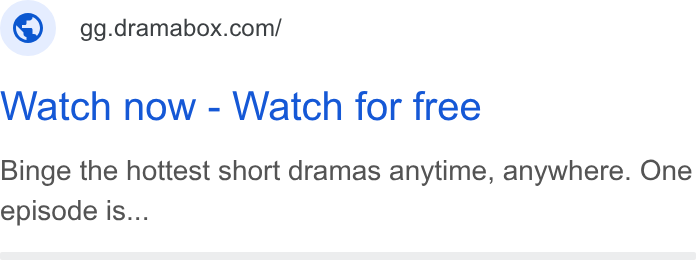
- gg.dramabox.com/ with a globe icon next to it. Below it, in blue text, is "Watch now - Watch for free".
- CTA / offer
- Watch now - Watch for free
- Audience
- People interested in 'short dramas' and free streaming content, indicated by the text 'Binge the hottest short dramas anytime, anywhere. One episode is...'
Why it works. Direct response ad using a clear value proposition and a curiosity gap to drive clicks to a free streaming service.
Direct benefit headline: "Watch now - Watch for free" Use a clear, benefit-driven headline that explicitly states the primary value proposition, especially if it involves 'free' access or content.
- Running
- 51 days (longevity = it's converting)
- Hook
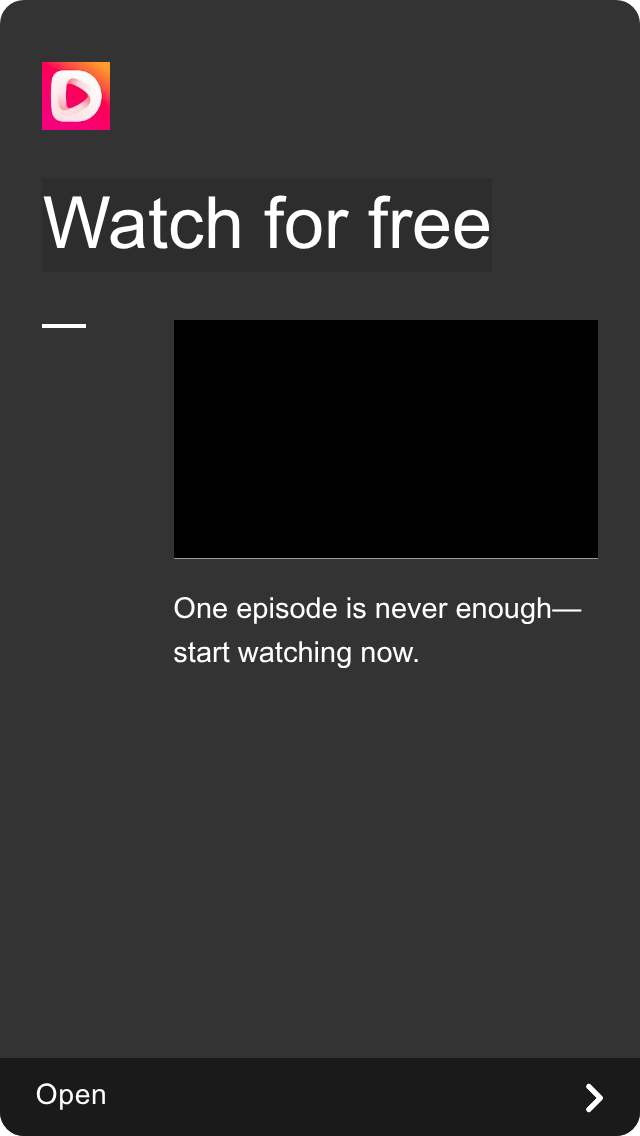
- Visual: A pink and orange play button logo in the top left corner, followed by the text "Watch for free".
- CTA / offer
- Open
- Audience
- Individuals interested in watching episodic content for free, indicated by the text "Watch for free" and "One episode is never enough— start watching now."
Why it works. This creative uses a direct value proposition and a curiosity gap to drive app installs for free content consumption.
Direct value proposition in headline: The ad prominently displays "Watch for free" at the top. Lead with a clear, concise, and compelling free offer as the primary headline in your ad creative.
07 The playbook
The channels are not separate. They are one system where each stage feeds the next. Here is the read, then the plays to run tomorrow.
The inferred playbook
The loop starts with a low-cost content factory that feeds three surfaces at once, and it has to keep outrunning friction on the monetization side.
The Google ad fleet and a network of TikTok and Instagram creators posting "search this code" or "link in bio" CTAs are the real top-of-funnel engines, not organic search or a founder audience.
Creator captions and ad creative funnel to "download and search the code" with almost no landing friction, but the payoff behind that unlock is a coin-and-subscription gate reported at $17.99-$19.99 per week (promo weeks as low as $3.99-$5.99) plus $3.99-$29.99 coin packs, a structure App Store and Trustpilot reviewers call aggressive, including recurring charges users say they did not expect.
Dig deeper+3▾
The near-daily upload cadence builds a persistent search and suggested-video surface that keeps paying back views long after any single ad campaign's budget runs out.
No visible founder or personal-brand channel and no documented affiliate or partner program mean the creator-seeding layer runs informally through uncredited "link in bio" creators rather than a scaled, trackable system.
how many free-episode viewers actually convert to a coin purchase or subscription, what DramaBox pays per install across its Google and LinkedIn fleet, and whether the recurring-billing complaints above reflect a broader churn problem or isolated cases.
Cliffhanger-clip funnel
The proofDramaBox's creator network cuts clips that stop mid-scene and route to a "search this code" unlock or a bio link, its top clip pulling 119,730 engagements.
The adaptationCut your own best content moment into a 30-45 second clip that stops right at the reveal or climax, captioned with one explicit next step (a link, a code word to DM, a specific page) instead of a vague call to action, then post it from both your brand account and a personal one to see which converts better. The mechanism: stopping at the climax plus a single unambiguous instruction is what turns a passive viewer into a click, not the production quality.
Cost: $0 · Time to signal: days · Works pre-PMF: yes
Localize the house account
The proofDramaBox runs a market-split TikTok presence, with "DramaBox- drama pendek" targeting Indonesian speakers using the same free-episode hook format as its English-led Instagram account.
The adaptationPick one underserved language or region for your own niche, translate your single best-performing hook line into it (not just auto-subtitle it), and post it from a dedicated locale-specific account rather than a repost, since a native-language handle earns more trust and algorithmic reach in that market than a translated caption on your main account. First step: identify your highest-engagement post, translate its hook line, and stand up one new account for it.
Cost: $0 · Time to signal: weeks · Works pre-PMF: yes, provided you already have one organic post proven to work
Recycle organic hooks into paid creative
The proofThe same curiosity and bold-claim phrasing appears across DramaBox's YouTube titles, creator captions, and its Google ad set, suggesting winning organic language gets promoted into paid tests rather than paid starting from scratch.
The adaptationBefore spending on ads, track which organic post titles or captions actually pull clicks, then lift the exact winning phrase, word for word, into your first paid test instead of writing new ad copy from a guess. First step: pull your top three organic captions by engagement and run each as a small text ad.
Cost: under $500 · Time to signal: days · Works pre-PMF: conditional, needs a few organic posts with real engagement data first
Ship a dedicated ad-landing domain
The proofEvery DramaBox Google ad displays a separate "gg.dramabox.com" subdomain instead of the main site, isolating paid traffic from organic for cleaner measurement.
The adaptationSet up a lightweight subdomain or dedicated redirect link exclusively for paid campaigns before you start spending, so paid conversion numbers never get muddied with organic traffic once you're running more than one channel. First step: point a free subdomain at your existing site with campaign tracking parameters built in from day one.
Cost: $0 · Time to signal: days · Works pre-PMF: yes
Run one always-on ad for a different audience
The proofDramaBox keeps a small LinkedIn presence, just 3 ads total but active for roughly 286 days, far from its consumer audience, more consistent with recruiting or investor-facing awareness than customer acquisition.
The adaptationIf you're hiring or fundraising, run one or two static ads on the platform that matches that specific audience (LinkedIn for talent or investors) on a separate budget from your consumer acquisition spend, and let it run untouched for months rather than optimizing it daily, since this is a low-intensity, high-patience channel. First step: write a single ad naming the exact role or funding stage and target it by job title.
Cost: under $500 · Time to signal: months · Works pre-PMF: conditional, only useful once you're actively hiring or fundraising, not for customer acquisition Not transferable at an earlier stage: the 76-ad Google fleet and the daily-upload professional content pipeline behind DramaBox's YouTube channel assume production and ad budgets a pre-PMF founder will not have; adapt the creative mechanics (the cliffhanger cut, the hook recycling, the localized account) rather than the volume.
You just read how DramaBox does it. Tomorrow it is someone else.
Every morning we take one company that is actually growing and break down where its customers come from: the ads still running after a year, the channel doing the real work, and the play you can run this week.
Systemaic · directional intelligence. Traffic, spend, and reach figures are SimilarWeb-style estimates and qualitative reads of public data, not audited numbers. Built on real public receipts.
// teardowns with a similar GTM motion
sources & receipts (16)
Live ad libraries: linkedin ad library · google ad library
Launch archives: Hacker News: DramaBox: An Open-Weight TTS That Reads Stage Directions
Researched facts: App launch date: DramaBox launched in April 2023 · Parent company: Beijing Dianzhong Technology Co., Ltd. (est. 2011-09-15), legal representa · Operating entity: DramaBox is operated by StoryMatrix Pte. Ltd. in Singapore, the internat · Disney Accelerator selection: DramaBox selected as one of only four companies in Disney's · 2026 fundraise target: DramaBox seeking to raise $100M from US backers at a $500M valuatio · Sensor Tower 2024 award: DramaBox won Sensor Tower's "2024 Best Short Drama App" award (As · Google Play 2024 award: DramaBox won Google Play's Best of 2024 award, Best for Fun catego · Q1 2025 in-app revenue: DramaBox generated $120M in global in-app revenue in Q1 2025 (+29% · App pricing (in-app purchases): Weekly Membership tiers at $17.99 and $19.99, plus special · Trade Desk deal executive: Wang Hefei, Head of Commercial at DramaBox, is quoted on the ra
Community threads: Trustpilot: User reports being billed weekly for coin top-ups he never intended as a recur · Apple App Store reviews: App Store reviewer calls the coin/subscription pricing 'GREED', s · JustAnswer (Q&A/comments): User seeking billing help doesn't recall signing up, just sees
Traffic, spend, and revenue figures are estimates as noted in the report; the links above are the primary public artifacts.