- 01Launch twice, under two different frames
- 02Turn your product's own output into a standing news hook
- 03Recruit creators with a comment-gate, not a link
- 04Bid on the confusion around a bigger rival's name
01 Snapshot
The one-glance read on who they are and how they grow. Each point is verifiable from the receipts above.
A free, crowdsourced benchmark where people vote on anonymized head-to-head AI outputs (websites, images, video, and more) across 13 categories, with 2M+ users across 190+ countries as of mid-2026.
Launch-led at the start, now running on a heavy creator-UGC engine layered on top of a live earned-media loop.
~1.44M estimated monthly visits (+4.2%) as of 2026-07-31, 7 active Meta ads as of the same date, and a lean team of roughly 3-5 people (YC lists 3, PitchBook 5).
Kamryn Ohly, the CTO, framed the whole premise in one line announcing the YC application: "If models can win IMO gold, why can't they put the best two fonts together?"
The durable engine here is not the launch or the ads, it's that the leaderboard is a living news source: every time a new frontier model takes a category, that fact alone hands outside writers and the founder a fresh, evergreen reason to post about Design Arena on Hacker News and X, at no production cost.
02 How it unfolded
The order the channels came online. Sequence is strategy: what they did first, and what they layered on once demand existed.
03 Traffic & channel mix
Estimated demand, the channel split behind it, and the keywords and referrers doing the work. Directional modeling, not audited analytics.
Design Arena draws an estimated ~1.44 million monthly visits, up 4.2% on the latest trend read. This pull doesn't include a channel-by-channel percentage split, so the clearest signal is on the keyword side: the top-ranking terms it captures are "lmarena ai" (#2), "imarena ai" (#4), "arena ai" (#4), and "llm arena" (#4), variants of the name of LMArena, a rival AI-model benchmark the founders directly referenced in their Hacker News launch thread as lacking a dedicated aesthetics lens. That means a meaningful slice of organic entry is confusion or spillover search meant for a more established competitor, not demand generated by Design Arena's own brand terms. That dynamic, a smaller player capturing search traffic adjacent to a bigger rival's name, is worth more than a raw percentage would be here.
04 Organic content
The specific pages earning their organic search traffic, and the pattern behind why they rank. Adapt the format, not the topic.
The organic footprint is almost entirely concentrated on the homepage, which pulls roughly 38,500 monthly organic visits against a next-largest page (the image leaderboard) at just 109. That single-URL concentration, rather than a network of individually ranking category pages, tells you the SEO motion is riding one entry point's brand/category-adjacent keyword capture (the LMArena-variant terms above) rather than a built-out content library. With 13 voting categories as the core product, none of the individual leaderboard subpages (image, video, and the general leaderboard) have become independent search assets yet, each pulling under 110 visits a month, which is the strategic gap a reader could actually close by treating each category page as its own SEO surface instead of leaving that work to the homepage.
Top pages by organic traffic
05 Channel map
Not traffic share. How much weight the growth system actually puts on each channel, with a one-line read on the role it plays.
What drove growth
06 The motions doing the work
For founder-led SaaS the breakdown shifts from ads to traction: where the first users came from, how the founder grows it in the open, and the compounding organic surface.
The first users came from a two-stage Hacker News launch that the founders have kept feeding ever since with a story that writes itself every time a new model tops a category.
CEO Grace Li's first Show HN, framed as a side project ("crowdsourced benchmark for AI-generated UI/UX"), hit 89 points and 29 comments on 2025-07-12, weeks before any YC or funding narrative existed.
A month later, the same team returned with "Launch HN: Design Arena (YC S25), Head-to-head AI benchmark for aesthetics," earning 74 points and 24 comments on 2025-08-12, a second front-page run under a new, funded-credibility frame rather than a repeat of the first pitch.
Dig deeper+2▾
Within four weeks of the initial launch the company reported 47,000 users across 136 countries, growing to 130,000+ by the time TechCrunch named it a YC Demo Day standout in September 2025, both figures from that specific moment, not the current state.
Unlike a one-time launch bump, outside writers keep submitting fresh "which model just won" posts to Hacker News well past launch, through February, June, and four times in July 2026, with the most recent, "Kimi K3's Design Secret May Be in Its Thinking Traces," reaching 33 points and 11 comments on 2026-07-30, the strongest of that later wave.
Kamryn Ohly, the CTO, is the build-in-public voice here, not a separate brand account, and the posts that work hardest are the personal ones, not the announcements.
The YC application post, the batch-feature post, and a lighthearted Demo Day merch joke ran in August-September 2025; the merch joke, the least "corporate" of the three, drew 134 likes and ≈25,900 views versus single-digit likes on the formal announcements.
A recurring format ties each frontier model release to the brand, from "Gemini 3 Pro currently takes #1 across all categories" (November 2025) to "GPT 5.6 Sol is on top of @DesignArena" (July 2026, 26 likes, 1,435 views), the latter also name-dropping OpenAI's Sam Altman commenting on design at a company event, pairing the founder's own data with someone else's news cycle.
Dig deeper+1▾
The two Reddit mentions in evidence are third-party posts, not self-posts from the team, so unlike the X cadence, Reddit here is earned mention territory rather than a channel the founders actively work.
The search motion leans on one strong entry point rather than a built content library, and the paid layer is split between a dormant Google test and an active Meta push.
The homepage's top keywords are variants of LMArena's name (the competing benchmark referenced above), meaning a real share of organic demand is spillover search rather than category terms Design Arena built itself.
Nearly all tracked organic traffic funnels through the homepage, while none of the 13 category leaderboard pages independently pull more than 110 visits a month, so the core product surface isn't yet doubling as a long-tail SEO asset.
Dig deeper+2▾
Three Google text ads targeted generic high-intent terms ("free ai logo generator," "no-code app builder," "free websites") rather than the brand's own name, a demand-generation bet, but all three are now inactive, suggesting Google Search wasn't worth sustaining next to Meta.
All 7 tracked Meta ads remain active as of 2026-07-31 (oldest ~63 days), built on a lifestyle creative, a child coloring at a desk under a lamp, paired with Hindi copy promising free access to the world's best models, a specific geographic and emotional bet rather than a feature pitch.
07 Paid ads
This founder-led SaaS also runs paid acquisition. Here are the live ads doing the work, each with the X-ray and a play you can adapt.

- Running
- 63 days (longevity = it's converting)
- Hook
- "DesignArena" logo and text, with a child drawing at a desk in a dimly lit room.
- Audience
- Individuals interested in design and AI, indicated by the company name 'DesignArena' and the implied ease of creation ('बनाएं। बिल्कुल मुफ्त।').
Why it works. This creative uses a relatable image of a child drawing to imply ease of use and accessibility for AI-generated design, aiming to attract new users to DesignArena.
Visual of a child engaged in a creative activity: a child is seen drawing at a wooden desk with crayons and paper. Use an image or video of a non-expert (e.g., a child, an elderly person, or someone clearly not a professional) easily using your product to demonstrate its simplicity and broad appeal.

- Running
- 59 days (longevity = it's converting)
- Hook
- "Create" on-screen text with a child sitting at a desk coloring a picture.
- CTA / offer
- for free
- Audience
- The image of a child coloring suggests a focus on creativity and accessibility, potentially targeting individuals interested in design, art, or creative tools, including those who might be new to design or looking for free resources.
Why it works. To position DesignArena as an accessible and free tool for creative expression, using a relatable image of a child engaged in art to evoke a sense of simple, uninhibited creation.
Prominent on-screen text: "Create" and "with DesignArena, for free." Use large, clear text to state your primary benefit and offer (e.g., 'Learn to Code, for free.') at the top of your static ad.

- Running
- 59 days (longevity = it's converting)
- Hook
- "Create" on-screen text with a child drawing at a desk under a lamp.
- CTA / offer
- for free
- Audience
- The image of a child drawing suggests a focus on creativity and accessibility, potentially targeting individuals interested in design, art, or creative tools, including those who might be new to such activities or looking for free resources.
Why it works. To attract users interested in creative tools by highlighting the ease and accessibility of design with a free offering.
Large, prominent on-screen text 'Create' at the top of the image. Use a single, powerful verb as the primary on-screen text in your ad's headline to immediately capture attention and pique curiosity about your product's core benefit.
Show 3 more ads

- Running
- 35 days (longevity = it's converting)
- Hook
- Design Arena www.designarena.ai/ Free Websites - Free, Professional Websites
- Audience
- Individuals or small businesses looking to create a website quickly and professionally without financial investment, indicated by 'Free Websites', 'Design fast', and 'Build professional and personal websites'.
Why it works. Direct response ad using a clear value proposition and keyword-rich text to attract users seeking free and professional website creation.
Prominent display of core benefit in the headline: 'Free Websites - Free, Professional Websites' Lead with your most compelling, no-cost benefit in the largest, most visible text on your ad creative.
- Running
- 34 days (longevity = it's converting)
- Hook
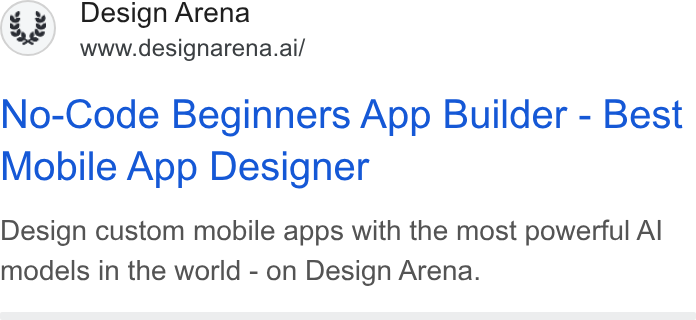
- Design Arena www.designarena.ai/ No-Code Beginners App Builder - Best Mobile App Designer
- Audience
- The phrases "Beginners App Builder" and "No-Code" signal that this product is for individuals without coding experience who want to create mobile apps.
Why it works. Direct-response value proposition to attract beginners to a no-code app builder.
Headline with a bold claim and key benefit: "No-Code Beginners App Builder - Best Mobile App Designer" Use a clear, benefit-driven headline that includes your core value proposition and a strong, but defensible, claim about your product's standing in the market.
- Running
- 12 days (new — still being tested)
- Hook
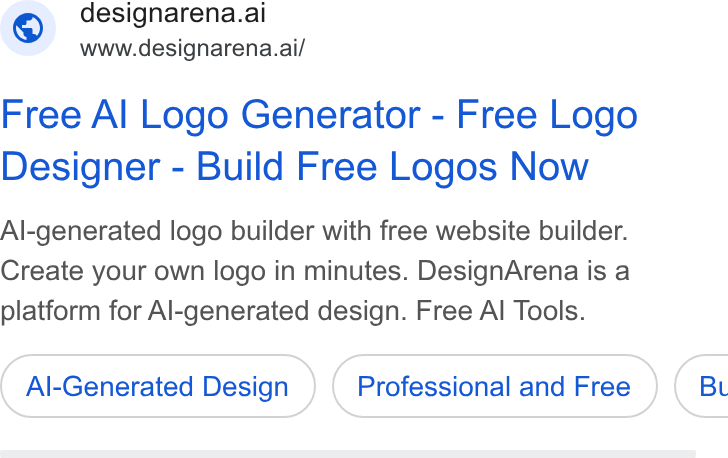
- designarena.ai www.designarena.ai/ Free AI Logo Generator - Free Logo Designer - Build Free Logos Now
- Audience
- Small business owners, entrepreneurs, and individuals needing branding solutions, indicated by the offer of 'Free AI Logo Generator' and 'Create your own logo in minutes'.
Why it works. This creative uses a direct response approach by highlighting a free, AI-powered solution for logo design to attract users seeking quick and affordable branding.
Headline with clear benefit and keyword optimization: 'Free AI Logo Generator - Free Logo Designer - Build Free Logos Now' Use a headline that clearly states the primary free benefit and the immediate outcome for the user, incorporating relevant keywords for search visibility.
08 The playbook
The channels are not separate. They are one system where each stage feeds the next. Here is the read, then the plays to run tomorrow.
The inferred playbook
The loop runs earned attention on Hacker News and creator platforms into a single strong entry point, with monetization still largely unproven in public.
Hacker News's recurring third-party leaderboard stories and a swarm of TikTok/Instagram creators both funnel new users in on the same curiosity hook, that every top AI model is usable for free through one interface.
About a third of creator posts use a comment-to-DM funnel rather than a direct link, meaning that slice of conversion depends on the creator's own follow-through rather than a one-click landing page, a slower but higher-trust path than a typical affiliate link.
Dig deeper+3▾
The live leaderboard itself is what compounds. Every new frontier model release gives both the founder and outside writers a fresh, low-cost reason to post again, an evergreen hook that a static product wouldn't have.
No public revenue or named enterprise customers appear anywhere in the evidence; given a free consumer product, undisclosed custom enterprise pricing, and a team of roughly 3-5, a reasonable estimate places current revenue in the pre-revenue-to-low-six-figures ARR range. This is an estimate, not a confirmed figure.
free-to-paid enterprise conversion or any named enterprise customer, the actual click-through from the creators' comment-gated DM funnel, and a reconciled funding number (public sources point to a $500K YC pre-seed round, unconfirmed publicly).
Launch twice, under two different frames
The proofGrace Li's first Show HN ran as a scrappy side project a month before the official Launch HN under the YC banner, and both earned independent front-page traction (89 and 74 points).
The adaptationLaunch your own product on Hacker News as a personal-project story first, then return a few weeks later with a second post reframed around whatever credibility signal you've earned since, a funding close, a customer win, a usage milestone, using the same one-paragraph problem statement plus live-link format both times so it reads as new news, not a repeat.
Cost: $0. Time to signal: days. Works pre-PMF: yes, provided the second post carries a genuinely new angle, since a same-frame repeat risks being flagged as low-effort.
Turn your product's own output into a standing news hook
The proofBecause Design Arena's leaderboard updates live, outside writers keep finding new reasons to submit "which model just won" posts to Hacker News well into 2026, without the company producing that content itself.
The adaptationIf your product generates any comparable or rankable output, prices, speed, quality scores, publish it as a public page that updates automatically, and mention in your own launch post that it will keep changing as new entrants appear. That live-update mechanic is exactly what gives outsiders a reason to write about it again every time the underlying data shifts.
Cost: under $500 to build a public data page. Time to signal: months, since it takes real volume before anyone treats it as citable. Works pre-PMF: conditional, it needs genuinely comparable data behind it at launch, or an empty leaderboard convinces no one.
Recruit creators with a comment-gate, not a link
The proofTwo dozen-plus TikTok and Instagram creators post about Design Arena, and a recurring subset use a "comment 'Arena' and I'll DM you the link" format, with the top Instagram posts reaching engagement in the tens of thousands, without any visible paid affiliate structure behind it.
The adaptationDM 10-20 creators in your niche offering free or early access in exchange for a short demo video using that same comment-gate call-to-action instead of a raw link. It manufactures a visible comment thread the platform reads as engagement, and it hands you a list of warm leads to follow up with directly.
Cost: $0-under $500 (product access, no ad spend). Time to signal: weeks. Works pre-PMF: yes, provided the product is demoable in a 15-30 second clip.
Bid on the confusion around a bigger rival's name
The proofDesign Arena's top-ranking keywords ("lmarena ai," "arena ai," "llm arena") are variants of a better-known competitor's name, not its own, meaning a slice of its organic entry rides search traffic meant for that rival.
The adaptationIdentify the two or three most-searched terms tied to your closest, more established competitor using a free keyword tool, then write a comparison page targeting that exact phrase, and once budget allows, test a small paid campaign bidding on that competitor's name plus modifiers like "alternative" or "vs" to intercept searchers who haven't picked a winner yet.
Cost: $0 for the content page, under $500 for a paid test. Time to signal: weeks. Works pre-PMF: yes for the content version; the paid version only pays off against a competitor with real existing search volume.
News-jack a bigger company's announcement with your own data point
The proofThe founder's highest-engagement leaderboard post landed the same week OpenAI's Sam Altman was drawing attention to design at a company event, pairing the founder's own leaderboard result with someone else's news cycle.
The adaptationWatch for the next adjacent industry announcement, a competitor's feature launch or a platform update, and within the same day, publish your own product's angle on it: a benchmark result, a before/after, a reaction thread, tagging the relevant account so it surfaces in that day's search and discussion volume.
Cost: $0. Time to signal: days. Works pre-PMF: yes, provided you already have a comparable data point ready before the news cycle passes; a post published days late misses the wave entirely. Not transferable at an earlier stage: the active Meta ad campaign and its Hindi-market localization assume paid budget and international targeting research most pre-revenue founders don't have yet. Adapt the emotional, lifestyle-led creative angle, not the spend level or geographic bet.
You just read how Design Arena does it. Tomorrow it is someone else.
Every morning we take one company that is actually growing and break down where its customers come from: the ads still running after a year, the channel doing the real work, and the play you can run this week.
Systemaic · directional intelligence. Traffic, spend, and reach figures are SimilarWeb-style estimates and qualitative reads of public data, not audited numbers. Built on real public receipts.
// teardowns with a similar GTM motion
sources & receipts (19)
Live ad libraries: meta ad library · google ad library
Launch archives: Hacker News: Kimi K3's Design Secret May Be in Its Thinking Traces · Hacker News: Show HN: DesignArena – crowdsourced benchmark for AI-generat · Hacker News: Launch HN: Design Arena (YC S25) – Head-to-head AI benchmark · Hacker News: How GLM-5.2 beat Fable 5 At Website Design · Hacker News: Show HN: Agent Runner – open-source agent harness to benchma · Hacker News: QuiverAI beats Gemini 3.1 Pro on SVG benchmarks on Design Ar
Researched facts: What Design Arena is: World's largest crowdsourced benchmark for AI-generated design, eval · Founding team and backgrounds: Founded 2025 by three Harvard friends: Grace Li (CEO, Harva · TechCrunch feature as YC Demo Day standout: TechCrunch named Design Arena one of the stand · Later-stage user/vote scale: Over 2,000,000 users across 190+ countries have voted, poweri · Funding round: Raised $500K in a Pre-Seed round; investors include Elora Capital, Hawk Hil · Financing status corroboration: Listed as venture-capital-backed, with a Pre-Seed round in · Pricing / business model: Free public access for voting and viewing leaderboards; custom-p · Enterprise/partnership contact channel: Business, partnership, and leaderboard-nomination · Voting/ranking methodology: Uses blind (model-identity-hidden) pairwise comparisons feedin · Notable product launch: Slides Arena: Relaunched 'Slides Arena', pitting Gamma, Alai, Clau
Community threads: Hacker News: Earlier Show HN thread has founders sharing early qualitative impressions fro
Traffic, spend, and revenue figures are estimates as noted in the report; the links above are the primary public artifacts.