- 01Bid on competitor brand terms with explicit displacement creative
- 02Build /compare/ pages as a dual-purpose asset: paid landing page, organic asset as the domain matures
- 03Open short-form video with a named failure persona before you mention your product
- 04Size a free tier to the point of genuine project completion, not a toy demo
01 Snapshot
The one-glance read on who they are and how they grow. Each point is verifiable from the receipts above.
A unified, credit-based API for real-time phone validation, email verification, and IP lookup, targeting e-commerce, fintech, marketing, and SaaS teams that need fraud prevention and data hygiene through a single endpoint.
Paid-led: Google search ads are the primary acquisition engine, with competitor-displacement creative as the dominant angle.
Publicly reported ~$223,135 MRR across 618 active paying subscriptions (~$361 blended ARPU); ~7,821 monthly visits up +42.7% over a 3-month tracking window; 10 active Google ads as of 2026-06-29.
1Lookup is buying market share by bidding aggressively on competitor brand keywords and fraud-pain search queries, using paid search to generate demand while a comparison-page SEO surface builds authority underneath.
02 How it unfolded
The order the channels came online. Sequence is strategy: what they did first, and what they layered on once demand existed.
03 Traffic & channel mix
Estimated demand, the channel split behind it, and the keywords and referrers doing the work. Directional modeling, not audited analytics.
Top search keywords
| Keyword | Volume | Weight | CPC |
|---|---|---|---|
| 1lookup | 1.3k | - | |
| phone validator | 8.1k | $2.03 | |
| phone number validation tool | 250 | $2.44 | |
| 1 lookup | 60 | - | |
| phone number verification | 3.8k | $2.06 |
Total monthly visits are estimated at approximately 7,821, up +42.7% over a 3-month tracking window. Organic search accounts for only about 103 of those visits per month, generated almost entirely by branded homepage queries, meaning more than 98% of inbound traffic arrives via paid search and direct. Google is the sole confirmed paid channel: 10 active ads as of 2026-06-29 capture category-intent queries ("phone validator," "phone number verification," with web-wide search volumes of 8,060 and 3,770 searches per month respectively) and competitor brand terms. No Meta advertising appears in the scraped data. The comparison pages (/compare/nexmo, /compare/ipapi, /compare/clearout) sit at index positions 24-48 with near-zero click-through, so the SEO surface exists structurally but is not yet contributing to traffic. A precise channel-by-channel split is not available from the traffic data, but the paid-to-organic ratio makes the motion clear: this is a paid-search-first business.
04 Organic content
The specific pages earning their organic search traffic, and the pattern behind why they rank. Adapt the format, not the topic.
The comparison-page strategy is the intended organic play: 1Lookup has built dedicated pages targeting "[Competitor] vs 1Lookup" commercial-intent searches for Nexmo, IPApi, and Clearout, which addresses the highest-intent buyer type in the category (someone who has already named an alternative). These pages rank at positions 24-48 with near-zero organic clicks, indicating that domain authority has not yet scaled enough to compete for those terms. Branded homepage traffic dominates the organic picture: approximately 94 of the roughly 103 monthly organic visits land on the homepage via branded queries, which means the comparison-page investment is a long-term structural bet, not a current traffic driver.
Top pages by organic traffic
05 Channel map
Not traffic share. How much weight the growth system actually puts on each channel, with a one-line read on the role it plays.
What drove growth
06 The motions doing the work
For founder-led SaaS the breakdown shifts from ads to traction: where the first users came from, how the founder grows it in the open, and the compounding organic surface.
The paid search channel, not a launch moment, is where 1Lookup's first customers appear to have come from.
The listing, titled "World's most accurate data verification platform" with both Robby Frank and Nadav Boaz listed as makers, earned 6 upvotes and 1 comment, well below the threshold for front-page placement or meaningful referral traffic.
No "Show HN" post and no Reddit thread driving 1Lookup-specific launch traffic appear in the evidence. Reddit activity from a founder-associated account (username Ranorkk) concerns a separate product (ScoutForge, an app-testing marketplace) and does not represent a 1Lookup launch moment.
Dig deeper+2▾
The oldest active Google ads date from August 2025, aligning with the Product Hunt listing, suggesting paid acquisition launched in parallel with the public debut rather than relying on organic launch distribution. The +42.7% traffic trend over a 3-month tracking window indicates the paid channel is scaling.
Given the minimal launch-day traction and the consistent Google Ads investment since August 2025, early paying customers most likely arrived through paid search targeting competitor brand terms and phone-validation intent queries, not a viral launch event.
The YouTube content series and a single high-engagement Instagram creator post are the most visible public touchpoints; no founder-led build-in-public motion is evident.
The 1LookupApp YouTube channel publishes pain-narrative short videos (under 60 seconds each), with 8 videos and per-video views ranging from 124 to 2,109. The format names a recognizable failure persona ("Chad" who buys cheap leads at scale, "Dave" who manually stalks leads across 50 browser tabs) and introduces the product as the resolution, the same creative angle that runs in the Google Ads.
Creator @favourite.engineer's Instagram reel comparing 1Lookup to Truecaller generated 1,898 engagements without any visible coordination, the highest single-content engagement signal in the evidence, and a hint that there is audience appetite for this product framing in the South Asian developer and growth community.
Dig deeper+1▾
No X, LinkedIn, or Reddit posts by founder Robby Frank about 1Lookup's milestones, product decisions, or growth story appear in the evidence. For a product at publicly reported ~$223k MRR, the absence of a founder narrative means there is no earned-media layer compounding alongside the paid channel.
Paid search carries virtually the entire traffic load; the organic content surface exists in structure but has not converted into meaningful visits.
The /compare/ directory targets the highest-intent commercial searches in the category for Nexmo, IPApi, and Clearout, pages explicitly structured as "X vs 1Lookup" comparisons. They rank at positions 24-48 with near-zero organic clicks, so the paid and organic strategies are running in parallel: ads capture competitor-intent buyers while the comparison pages build domain authority for the same searches over time.
A partner and affiliate program at 1lookup.io/affiliate could compound distribution beyond paid search if it recruits adjacent operators (CRMs, lead-gen tools, marketing automation consultants whose clients are the exact 1Lookup buyer). Its activity and volume are not visible in public data.
Dig deeper+2▾
As of 2026-06-29, 10 of 39 total Google ads are active, with the longest-running active ad at approximately 313 days. Proven-winner creative centers on competitor displacement ("Better than HLR Lookup," "IPQualityScore vs 1Lookup > IPQualityScore") and outcome hooks ("Catch 87% More Fraud Sign-ups," "Try Phone Validation For Free - 99% Accurate"). The test creatives in the active set expand beyond pure-fraud messaging into carrier-data positioning ("Real-Time Carrier & Porting Info") and general validation ("Validate Phone & Email"), suggesting the campaign is broadening its angle set. Every active ad is demand capture: intercepting buyers who have already defined a category need, not building top-of-funnel brand awareness.
The site links to a blog, but no post titles or engagement data are visible in the evidence; its contribution to organic traffic is not assessable from public signals.
07 Paid ads
This founder-led SaaS also runs paid acquisition. Here are the live ads doing the work, each with the X-ray and a play you can adapt.
- Running
- 313 days (longevity = it's converting)
- Hook
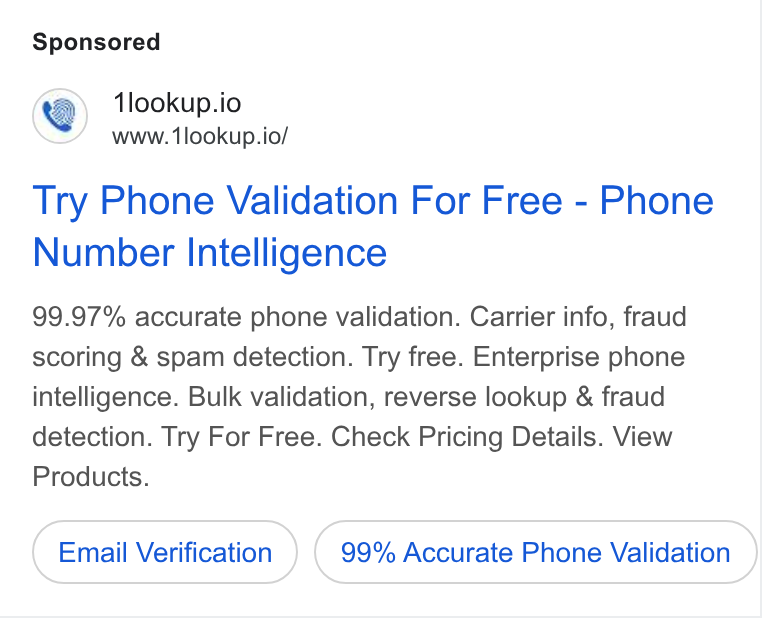
- Sponsored 1lookup.io www.1lookup.io/ Try Phone Validation For Free - Phone Number Intelligence
- CTA / offer
- Try Phone Validation For Free
- Audience
- Businesses or individuals concerned with data accuracy, fraud prevention, and efficient communication, indicated by terms like "Enterprise phone intelligence," "fraud scoring," and "Bulk validation."
Why it works. Removes the cost objection upfront with a free offer while still naming the specific service, good for cold search traffic.
Headline with a clear offer: "Try Phone Validation For Free - Phone Number Intelligence" Put the word free directly next to your core service name in the headline, not buried in the description.
- Running
- 312 days (longevity = it's converting)
- Hook
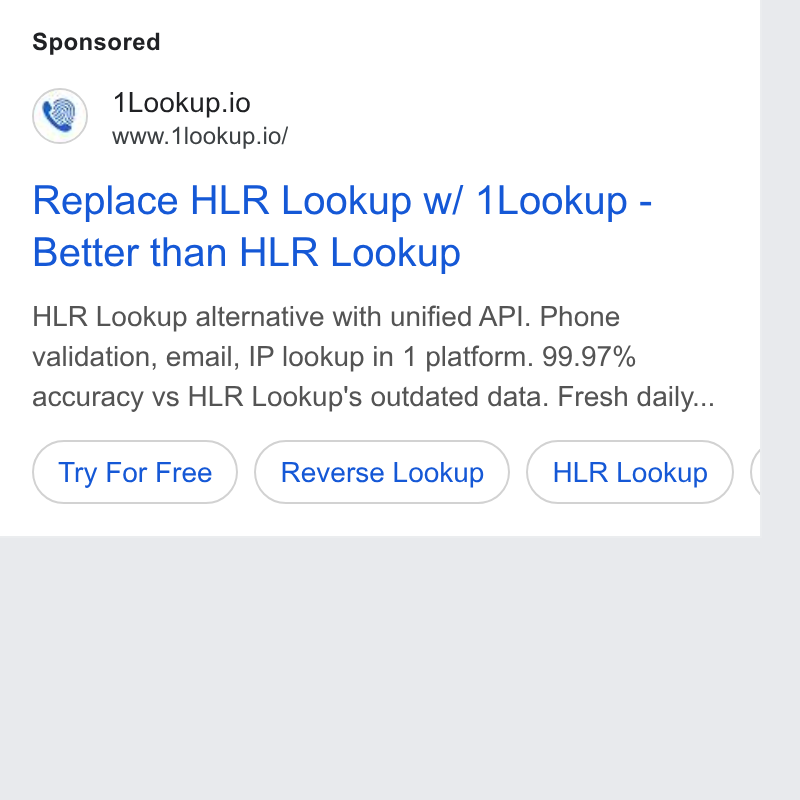
- Sponsored" text at the top left, with a small circular logo featuring a blue fingerprint icon on a white background, next to "1Lookup.io" and "www.1lookup.io/". Below this is the blue headline "Replace HLR Lookup w/ 1Lookup - Better than HLR Lookup".
- CTA / offer
- Try For Free
- Audience
- Businesses or developers who use HLR Lookup services, indicated by the direct comparison and technical terms like 'unified API', 'phone validation', 'email, IP lookup'.
Why it works. The word replace frames switching as a simple swap rather than a full migration project, lowering perceived switching effort.
Direct competitive comparison in headline: "Replace HLR Lookup w/ 1Lookup - Better than HLR Lookup" Use the word replace rather than compare when your product is a drop-in substitute for a competitor's tool.
- Running
- 306 days (longevity = it's converting)
- Hook
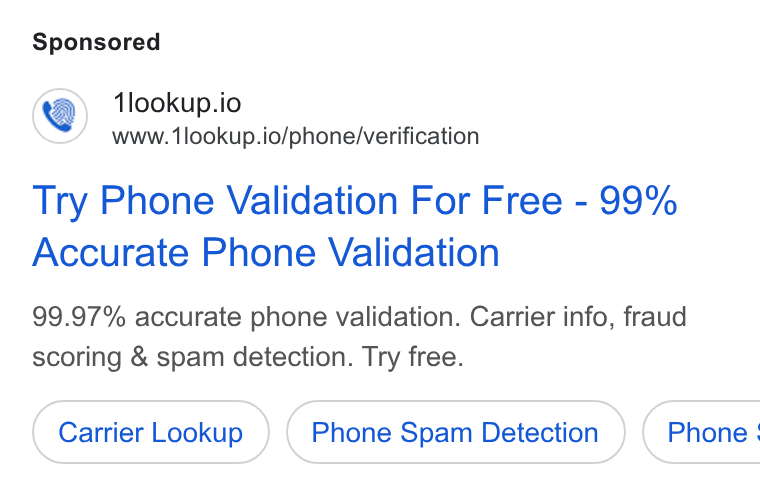
- Sponsored 1lookup.io www.1lookup.io/phone/verification Try Phone Validation For Free - 99% Accurate Phone Validation
- CTA / offer
- Try Phone Validation For Free
- Audience
- Businesses or individuals needing phone verification services, indicated by 'Carrier info, fraud scoring & spam detection'.
Why it works. Combines a no-cost trial with a specific accuracy number, addressing both the price objection and the trust objection in one headline.
Headline with a strong claim and free offer: "Try Phone Validation For Free - 99% Accurate Phone Validation" Pair your free trial offer with your single best accuracy or performance stat in the same headline.
Show 3 more ads
- Running
- 305 days (longevity = it's converting)
- Hook
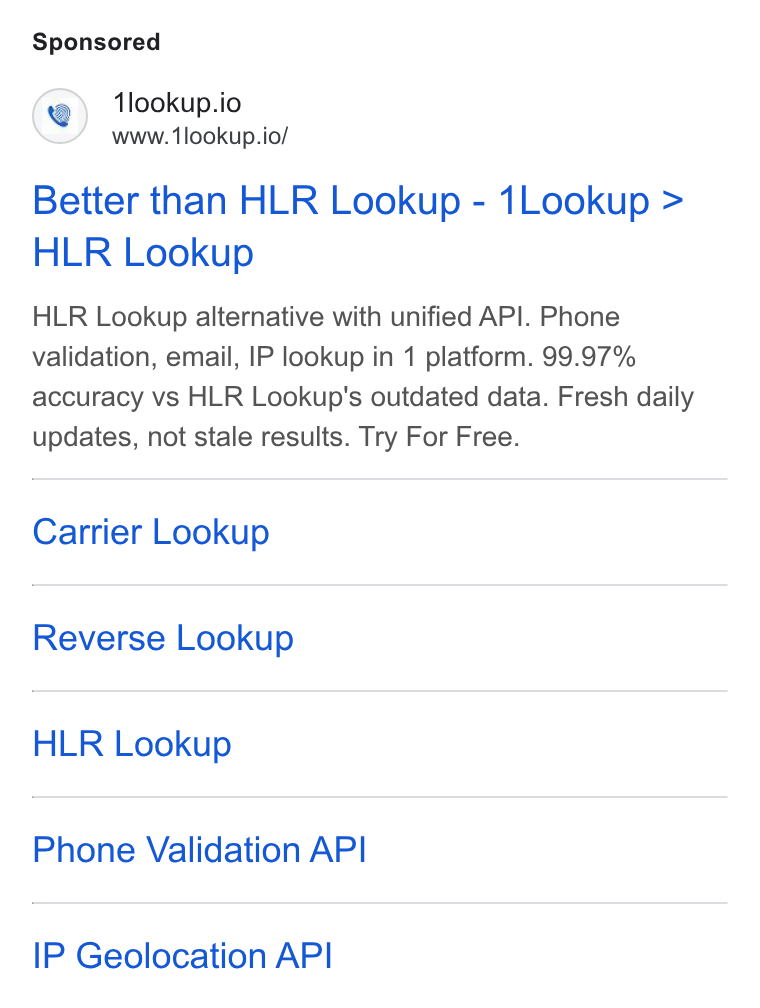
- Visual: A sponsored ad with a logo of a stylized ear/fingerprint icon, text "1lookup.io" and "www.1lookup.io/". Headline: "Better than HLR Lookup - 1Lookup > HLR Lookup".
- CTA / offer
- Try For Free.
- Audience
- Businesses or developers needing phone validation, email, or IP lookup services, indicated by terms like "HLR Lookup", "unified API", "Phone validation API", and "IP Geolocation API".
Why it works. Names a specific niche competitor by its category term, HLR Lookup, catching searchers who already know exactly what they need.
Direct competitive comparison in the headline: "Better than HLR Lookup - 1Lookup > HLR Lookup". If you compete on a technical category term rather than a brand name, put that exact term head-to-head with yours using a > symbol.
- Running
- 129 days (longevity = it's converting)
- Hook
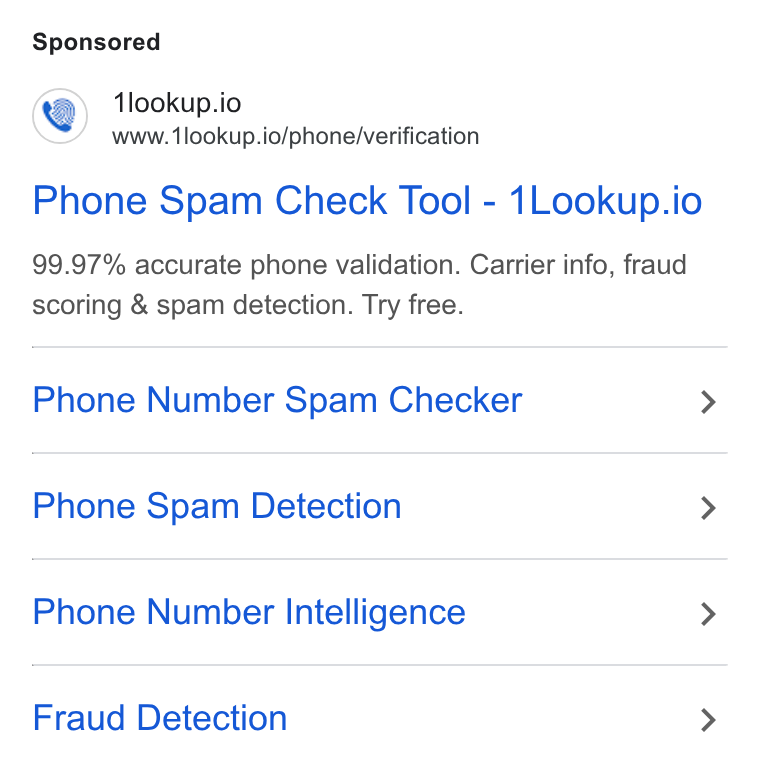
- Visual: The word "Sponsored" at the top, followed by a logo of a fingerprint inside a phone icon, and the text "1lookup.io" and "www.1lookup.io/phone/verification". Text: "Sponsored" and "1lookup.io Phone Spam Check Tool - 1Lookup.io"
- CTA / offer
- Try free.
- Audience
- Businesses or individuals concerned with phone spam, fraud, and needing phone number validation, indicated by the detailed service descriptions.
Why it works. Targets a narrow search intent, checking if a number is spam, rather than the broad validation category, so it converts higher-intent clicks.
Headline clearly states the product's primary function and brand: "Phone Spam Check Tool - 1Lookup.io" Create a headline around one narrow specific use case of your tool, not just its general product category.

- Running
- 104 days (longevity = it's converting)
- Hook
- The top left corner shows a light blue circle with a white 'i' icon, next to a blue fingerprint icon within a phone receiver shape, and the text "1LOOKUP" underlined. The main headline "Smart Fraud Scoring" is prominently displayed.
- CTA / offer
- Sign Up
- Audience
- Businesses or individuals concerned with fraud prevention, indicated by the terms "Fraud Scoring" and "Validate phone, email, and IP instantly."
Why it works. Positions the product above a basic validation check by framing it as intelligent scoring, appealing to risk teams who need nuance not a binary flag.
Prominent headline and sub-headline: "Smart Fraud Scoring" and "Validate phone, email, and IP instantly." If your tool outputs a score rather than a binary result, lead with that nuance in the headline instead of a generic feature name.
08 In their own words
Pulled from interviews and community sessions. The quotes are the angle; the takeaway is what to do with it.
Nadav Boaz: How VoiceDrop Hit $150k MRR in 18 Months (SEO + Cold Email) ↗Founder Views · 93 views · 57 min▶ View source“Three golden pillars of a new business are SEO, Google PPC and cold emails. We always focus on these three because they also help each other. They work with synergy.”
Expand
Nadav Boaz grew VoiceDrop to $150k MRR in 18 months by running three synergistic channels simultaneously: SEO for compounding free traffic, cold email for immediate reach at near-zero cost, and Google PPC to capture existing demand. He boosted free-trial-to-paid conversion from 12% to 50%+ by adding a credit-card pre-authorization gate that filtered out non-buyers before they entered the funnel. His cold-email expertise from a prior agency (Primatica) gave VoiceDrop an unfair distribution advantage from day one.
“We could reach to 100,000 people, new people daily for, I don't know, $1,000 a month. That's numbers you don't see anywhere else.”
“The first metric that actually boosted us from around 12% to 50% conversion rate was some solution that we implemented — a pre-authorization. When someone tries to start a free trial in Voice, we check his card and we check if he got money on the card.”
“People that never meant to pay, they will complain. People that are willing to pay, they will find a way to use your product.”
“We start with SEO. We have our SEO strategies on how to be first in Google, how to beat our competitors, how to appear when someone is searching for our competitors, how to appear just under them. And so we start with that because SEO is a long-term game and it will give you free traffic. Then we usually also start with cold emails. When we do cold emails, people search for our brand in Google... that helps the SEO. It shows Google that people are looking for us.”
Launch SEO and cold email simultaneously from day one — cold email drives branded searches that signal authority to Google, compressing the timeline to rank.
Gate free trials with a credit-card pre-authorization (hold a refundable deposit, never charge it) to filter non-buyers before they consume support resources; VoiceDrop went from 12% to ~50% trial-to-paid conversion with this single change.
Build a VA + SOP + AI content machine: write one SOP for article creation, hire VAs who follow it with AI assistance, and a good VA can produce 5–10 SEO articles per day — hundreds of quality pieces within a few months.
Use cold email to schedule meetings and create human connections, not to auto-convert to a $20/month SaaS — sequence 7 steps, wait 2 days between emails early on, run 10 template variants per step with A/B testing, and keep adding steps as long as reply rates stay above 1%.
Position as high-ticket from the start and turn away clients who won't meet your floor — VoiceDrop set $500/month as the original minimum and said no to anyone below it, which kept support load manageable and justified investing heavily in customer success for every trial.
09 The playbook
The channels are not separate. They are one system where each stage feeds the next. Here is the read, then the plays to run tomorrow.
The inferred playbook
1Lookup's acquisition loop is a paid-search-first motion: attention is bought on Google, converted through a no-CC free trial, and monetized on a credit-based subscription. Attention starts at Google, where buyers searching competitor brand names (HLR Lookup, IPQualityScore) and phone-validation intent queries encounter displacement ads with explicit "X vs 1Lookup" or "Better than X" creative, pointing to competitor-specific landing pages.
A no-credit-card free trial (1,000 lookups) removes the barrier to first API call. The $99/mo entry tier, the $2,000/mo enterprise ceiling, and the ~$361 blended ARPU across 618 subscriptions indicate a mix of self-serve SMB accounts and mid-market buyers scaling credit usage over time.
The comparison-page directory, the affiliate program, and the YouTube content series signal intent to build a compounding surface, but none is generating meaningful traffic yet. If domain authority grows as the paid campaign drives brand-name search volume, the comparison pages could eventually capture organically the same competitor-intent buyers the ads fund.
Dig deeper+1▾
The playbook is entirely dependent on paid spend, with no founder-led narrative, no community flywheel, and no visible referral program activity. Free-to-paid conversion rate and churn are not visible in public data, making it difficult to assess how durable the current MRR is or how far the paid channel can scale before CAC becomes a ceiling.
Bid on competitor brand terms with explicit displacement creative
The proof1Lookup runs Google ads with headlines that name competitors directly: "IPQualityScore vs 1Lookup: 1Lookup > IPQualityScore," "Better than HLR Lookup," and "Replace HLR Lookup w/ 1Lookup." These ads are among the longest-running in their library, with the oldest active placement running approximately 313 days, a reliable signal of positive ROI.
The adaptationIdentify the 3-5 most-searched competitor names in your category using Google Keyword Planner. Create dedicated text ads targeting each competitor's brand term, with headlines that name the comparison explicitly (for example: "[Competitor] vs [Your Product]: See the Difference"). Build a dedicated landing page per competitor to improve ad relevance and Quality Score. Start with the competitor that generates the highest branded search volume in your category, measure CAC against your paid tier on that one first, and expand only once unit economics are confirmed. The mechanism: a buyer searching a specific competitor by name has already defined the category and their budget expectations; you intercept intent at its most specific point, before they reach the competitor's homepage.
Build /compare/ pages as a dual-purpose asset: paid landing page, organic asset as the domain matures
The proof1Lookup has built /compare/nexmo, /compare/ipapi, and /compare/clearout, pages structured as explicit "Competitor vs 1Lookup" comparisons. These rank at positions 24-48 with near-zero organic clicks, but the paid ads already point buyers to competitor-branded URLs, so the pages earn conversions long before the organic rankings mature.
The adaptationFor any SaaS or API product, create a comparison page for each major alternative in your category. Treat each as a paid ad landing page first: route paid competitor-bidding traffic to it from day one, so the page earns conversions and message-test data while its organic rankings are still climbing. (Paid clicks do not improve organic rankings; the payoff during the wait is revenue and learning.) Write the page as a genuine comparison (feature matrix, pricing table, clear differentiator statement) rather than a one-sided attack, since buyers at this intent level are evaluating seriously. Start with the competitor your best current customers say they evaluated before choosing you, build that page, and run a small Google Ads test pointing to it before expanding the set. The mechanism: comparison-page content attracts the highest-intent organic buyers (those who have already named a specific alternative) and improves ad Quality Score simultaneously, reducing CPC while planting a long-term organic asset.
Open short-form video with a named failure persona before you mention your product
The proof1Lookup's YouTube videos consistently lead with a recognizable failure character: "Chad" who buys 10,000 cheap leads thinking he scored a deal, "Dave" who digs through 50 browser tabs to find one email address, a sales floor "pitching to ghosts." The product appears as the resolution only after the problem has landed. The two most-viewed videos (2,109 and 2,082 views) use this structure, and the Google Ad creative mirrors it with hooks like "The Hidden Tax Killing Your ROI" and "The Silent Killer in Your CRM."
The adaptationFor a B2B SaaS product, create short videos (under 60 seconds) that open by naming a specific failure persona your buyers will recognize from their own teams. Give the persona a name, a plausible role, and a behavior that costs the business money without the persona realizing it. Introduce your product as the shift from that behavior, not as the subject of the video. Start by listing the 3 most memorable failure patterns your best customers describe on sales calls, pick the one most likely to make a buyer wince in recognition, and film a single video before committing to a series. This format transfers to LinkedIn native video, YouTube shorts, and ad creative without major rework. The mechanism: naming a character externalizes the problem (it is "Chad's" thinking, not the buyer's fault), which reduces defensiveness and increases the likelihood that the buyer self-identifies without feeling implicated.
Size a free tier to the point of genuine project completion, not a toy demo
The proof1Lookup's free trial offers 1,000 API calls with no credit card required. The $99/mo entry plan and ~$361 blended ARPU across 618 subscriptions suggest a functioning free-to-paid path at the self-serve SMB level, where developers integrate before any billing conversation occurs.
The adaptationIf you sell a developer-facing API or data tool, define the specific moment of genuine value delivery for your product (a validated lookup on real data, a completed batch, a clean API response integrated into a real workflow) and set the free-tier limit so a real test project hits it naturally rather than running dry before the user sees anything useful. The conversion trigger should not be a countdown clock: it should be hitting the limit mid-project, after integration is already complete and the switching cost of leaving is real. A no-CC entry point treats the free tier as the top of a self-serve funnel where the user qualifies themselves through usage before a billing conversation is necessary. The mechanism: developers convert after they have already integrated the API into a live workflow; at that point the decision is "continue for $X/mo" rather than "evaluate whether to try this," and the switching cost makes continuation the path of least resistance.
Recruit affiliate partners from the adjacent-tool ecosystem your buyers already use
The proof1Lookup has a partner and affiliate program at 1lookup.io/affiliate. A phone and email verification API integrates naturally with CRMs, lead-gen platforms, marketing automation tools, and e-commerce fraud stacks, giving it natural distribution access through the consultants and agencies who already serve those buyers in adjacent contexts.
The adaptationBefore recruiting generic traffic affiliates, survey your 10 best customers on what other tools sit in the same workflow as yours. Build a list of those adjacent tools and find the consultant networks, agency ecosystems, or niche newsletters built around each of them. Approach 5-10 operators who already serve your exact buyer with non-competing products and propose a referral arrangement where they can position your product as a complement to workflows their clients are already running. The first step is that survey of your top customers, which costs nothing and produces a prioritized list of exactly where to look for high-context referral partners. The mechanism: a referral from a trusted adjacent vendor arrives with context the buyer already accepts (the problem is defined, the budget category is familiar, the recommender has credibility), which converts at a materially higher rate than cold paid acquisition.
You just read how 1Lookup does it. Tomorrow it is someone else.
Every morning we take one company that is actually growing and break down where its customers come from: the ads still running after a year, the channel doing the real work, and the play you can run this week.
Systemaic · directional intelligence. Traffic, spend, and reach figures are SimilarWeb-style estimates and qualitative reads of public data, not audited numbers. Built on real public receipts.
// teardowns with a similar GTM motion
sources & receipts (2)
Live ad libraries: google ad library
Founder interviews: Nadav Boaz: How VoiceDrop Hit $150k MRR in 18 Months (SEO + Cold Email
Traffic, spend, and revenue figures are estimates as noted in the report; the links above are the primary public artifacts.