- 01Make the product the creative
- 02Gate a feature on a referral, not a paywall
- 03Write competitor reviews that serve two masters
- 04Intercept your audience at their transition moment
01 Snapshot
The one-glance read on who they are and how they grow. Each point is verifiable from the receipts above.
Sprout is an AI job-search app where users swipe right to auto-apply to listings, with a tailored resume generated per application; it reached $250K MRR in 8 months.
Creator-led organic growth, with Google search ads layered on top to harvest the demand TikTok virality creates.
~519K monthly visits (+46.7% over the last 3 months), a reported peak of $250K MRR (now sustaining ~$200K), an estimated hundreds of millions of monthly UGC views across TikTok, Instagram, and YouTube (a rough order-of-magnitude figure inferred from a reported network of ~200 creators, not a measured total), and 20 active Google text ads as of 2026-07-04.
As of 2026-07-04, a Google ad reading "Sprout For Employers" is testing a B2B supply-side angle with no parallel in the core job-seeker creative set.
The swipe-to-apply mechanic is filmable in 20 seconds; creators generated an estimated hundreds of millions of monthly views without Sprout producing any content, making the product's UX the ad creative.
02 How it unfolded
The order the channels came online. Sequence is strategy: what they did first, and what they layered on once demand existed.
03 Traffic & channel mix
Estimated demand, the channel split behind it, and the keywords and referrers doing the work. Directional modeling, not audited analytics.
Traffic sources
Top search keywords
| Keyword | Volume | Weight | CPC |
|---|---|---|---|
| sprout | 153k | $0.56 | |
| sprout jobs | 13k | $0.95 | |
| usesprout | 5.3k | - | |
| sprout ai | 7.3k | $2.01 | |
| sprout job search | 2.8k | $1.44 |
Top referring sites
Closest competitors by audience
~518,717 estimated monthly visits, up +46.7% over the last 3 months. Three channels carry the weight. Organic search leads at 43.9%, built on branded queries Sprout holds at position #1 for "sprout job app," "sprout jobs," and "prep ai jobs" (not "ai job finder," where Jobright and others outrank it). The brand term "sprout" draws approximately 153,000 monthly searches across the web, though Sprout Social, an enterprise social-media tool, appears as a named traffic competitor, creating a naming collision where some branded search intent leaks to a same-named company. Direct at 27.8% reflects brand recall built by months of TikTok virality among users who remembered the domain and typed it without searching. Referrals at 13.7% trace directly to the affiliate and creator discount-code program: creators posting codes like RIYRAI15 generate trackable click flows that land in this bucket.
Paid search (5.7%), social organic (4%), email (3.6%), and display, social paid, and Gen AI traffic together account for the remaining 1.3%.
The referring domain oncampusnation.com, a college-student content network, confirms the new-grad audience is real and routing to Sprout through on-campus media. Simplify.jobs appears as a primary traffic competitor alongside indeed.com and linkedin.com, signaling that Sprout competes for the same job-seeker search intent as the largest platforms in the category.
04 Organic content
The specific pages earning their organic search traffic, and the pattern behind why they rank. Adapt the format, not the topic.
Sprout's blog runs two distinct plays. The first targets college students at a life transition that precedes job-hunting: posts on summa cum laude and magna cum laude requirements intercept graduating students who are searching for academic context, planting the Sprout brand weeks before purchase intent forms. The second is a competitor-review cluster targeting job seekers already shopping alternatives: review posts on Teal and Mercor, two job-search and career tools competing in the same space, pull high-intent comparison traffic from searchers typing "[competitor] alternatives" or "[competitor] review" into Google. Both review pages also serve as Google ad destinations, meaning the same URL earns traffic from organic and paid search simultaneously.
Top pages by organic traffic
05 Channel map
Not traffic share. How much weight the growth system actually puts on each channel, with a one-line read on the role it plays.
What drove growth
06 The motions doing the work
For founder-led SaaS the breakdown shifts from ads to traction: where the first users came from, how the founder grows it in the open, and the compounding organic surface.
Sprout's first users arrived through organic TikTok creator posts, with Reddit inquiry threads mapping the awareness arc from short-video clip to credibility check.
A r/jobs thread asking "Does Prep AI actually work?" dates to July 2025, predating the earliest creator UGC in the evidence, suggesting word-of-mouth was circulating through informal channels before any public creator program existed.
TikTok posts tagged #prepai appear from August 2025; one creator's clip reached approximately 57,000 engagements by August 19 with no paid amplification, and multiple creators followed within weeks posting demo and reaction content under the same hashtags.
Dig deeper+2▾
The rename from Prep.ai to Sprout happened between August and September 2025; early creator UGC used both names and hashtags interchangeably (#prepai and #sprout together), and at least one Google ad still runs under "Prep AI - Apply to Jobs Instantly," preserving search equity from the original brand identity.
A Starter Story (an indie-founder media publication that profiles bootstrapped businesses) Instagram reel credited the "Tinder for jobs" framing and cited $150K in monthly revenue at time of publication; reposted by the brand account, it brought the origin story to a founder and operator audience and added a third-party credibility layer on top of the UGC-driven growth narrative.
Nicole, Sprout's co-founder, grows the company through a creator affiliate network rather than personal founder content on X or LinkedIn; her technical co-founder Aaron (a YC and HFZ alum) handles the app's React Native build.
The affiliate program turned creators into the de facto public voice: an August 2025 clip in which a creator walks through the referral mechanic ("if you can't pay, you can check out the referral system that gives you free access to swiping for jobs") functions as product-education content produced entirely outside the brand's own accounts.
The Starter Story reel reposted to the brand's Instagram is the closest analog to a founder build-in-public post in the evidence: it surfaces the 8-month growth arc, the non-technical founder angle, and the $150K MRR figure from time of publication for an audience of other builders; the reel itself, posted by the distinct @starter_story account rather than usesprout's own 13-post brand account, earned 311 engagements.
Dig deeper+1▾
Third-party threads ("I keep seeing TikToks...is it really good marketing or is the app actually good?", 68 points and 108 comments in r/jobsearchhacks) serve as organic social proof without any founder participation, because the UGC volume was large enough that Reddit inquiry became a predictable downstream effect.
Organic search at 43.9% of traffic is built almost entirely on branded rank dominance and a precisely targeted two-track blog, with comparison pages that also pull double duty in the paid search campaign.
Sprout holds position #1 for "sprout job app," "sprout job search," "sprout jobs," and "prep ai jobs" (not "ai job finder," where Jobright and others outrank it); the homepage earns 65.3% of all measurable organic visits on these branded and near-branded terms, a reflection of the brand awareness the TikTok creator volume built before a single Google ad ran.
The competitor review posts covered in the Organic Content section above double as Google ad destinations in the same campaign; Sprout pays to send high-intent comparison-shopping traffic directly to pages already earning organic visits, so each review post pays back on two timelines from one piece of content.
Dig deeper+2▾
The affiliate program at usesprout.com/affiliate-program formalizes creator recruitment, and 13.7% of total traffic arriving via referrals is the clearest evidence of its reach. Creator discount codes serve two functions simultaneously: they make creator content feel exclusive and trackable, and they give Sprout performance data on which creators drive paying conversions.
As of 2026-07-04, 20 active text ads capture branded intent, competitor comparison searches, and category queries. The 15 longest-running ads (~101 days) anchor the budget; 5 active tests include the "Sprout For Employers" B2B angle and a mobile-download-focused ad. The 12 previously-run TikTok ads show zero active time as of 2026-07-04, suggesting the organic creator flywheel has made paid TikTok unnecessary or the spend has been paused.
07 Paid ads
This founder-led SaaS also runs paid acquisition. Here are the live ads doing the work, each with the X-ray and a play you can adapt.
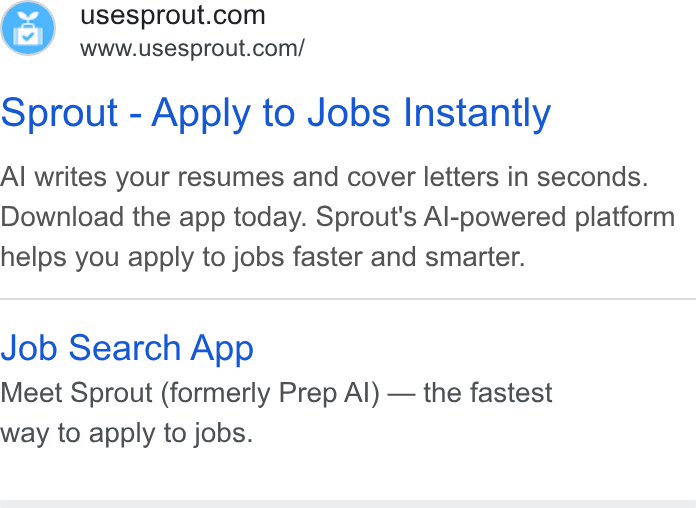
- Running
- 101 days (longevity = it's converting)
- Hook
- usesprout.com www.usesprout.com/ Sprout - Apply to Jobs Instantly
- CTA / offer
- Download the app today.
- Audience
- Job seekers who are frustrated with the time and effort involved in applying for jobs, indicated by phrases like 'Apply to Jobs Instantly' and 'faster and smarter'.
Why it works. Strips the headline to brand plus a single speed word for high-intent searchers who already know what a job app tool is.
Headline with a strong, benefit-driven claim: 'Sprout - Apply to Jobs Instantly' Test a headline that is just your brand name plus one speed-word claim for high-intent search queries.
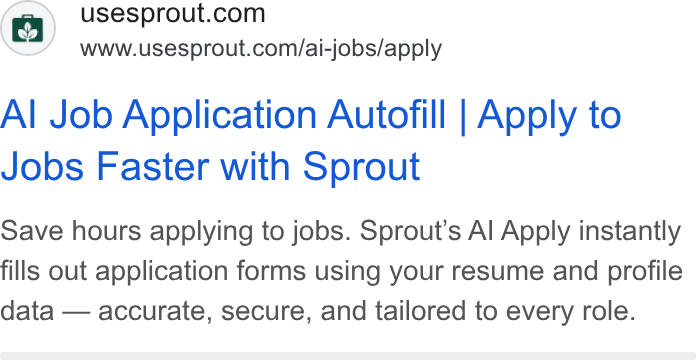
- Running
- 70 days (longevity = it's converting)
- Hook
- usesprout.com www.usesprout.com/ai-jobs/apply AI Job Application Autofill | Apply to Jobs Faster with Sprout
- CTA / offer
- Apply to Jobs Faster with Sprout
- Audience
- Individuals actively applying for jobs, indicated by phrases like "AI Job Application Autofill" and "Save hours applying to jobs."
Why it works. Positions autofill as the fix for retyping the same form for the hundredth time, aimed at job seekers already searching apply-related terms.
Headline directly addresses a pain point and offers a solution: "AI Job Application Autofill | Apply to Jobs Faster with Sprout" Name the exact mechanical friction your tool removes, like autofill or one-click, right next to the speed benefit in your headline.
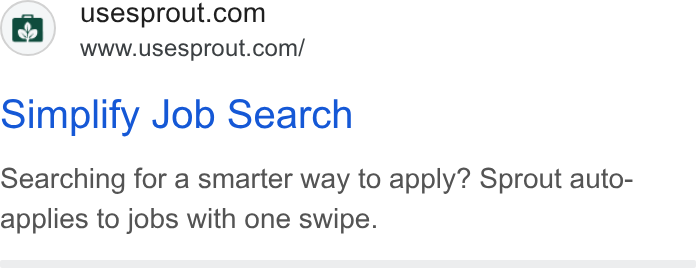
- Running
- 70 days (longevity = it's converting)
- Hook
- Image shows a green briefcase icon with a plant sprout inside, next to "usesprout.com" and "www.usesprout.com/". Below this is the blue text "Simplify Job Search".
- CTA / offer
- Sprout auto-applies to jobs with one swipe.
- Audience
- Individuals actively searching for jobs and finding the application process cumbersome, indicated by the text 'Searching for a smarter way to apply?'.
Why it works. Matches low-effort search-ad real estate by mirroring the searcher's own query back with a one-word promise.
Headline directly addresses a pain point: 'Simplify Job Search'. For search ads, try a headline under four words that restates the searcher's problem plus your one-word fix.
Show 3 more ads
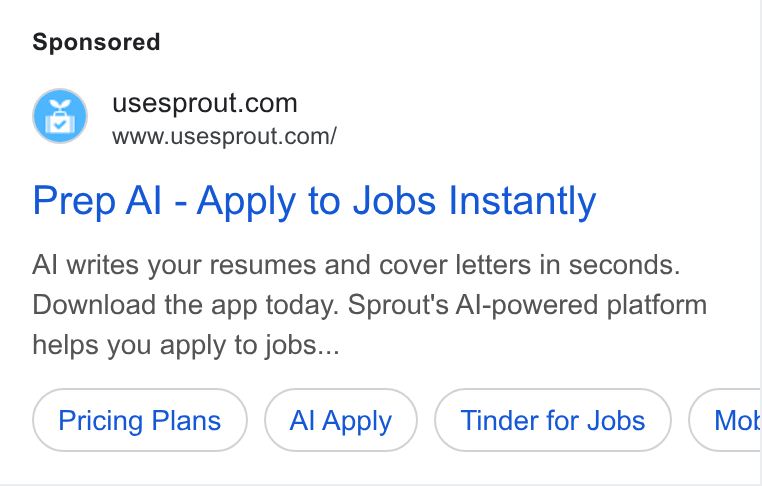
- Running
- 59 days (longevity = it's converting)
- Hook
- Prep Al - Apply to Jobs Instantly" with a blue icon of a shopping bag with a checkmark inside, and the text "usesprout.com www.usesprout.com/" below "Sponsored".
- CTA / offer
- Download the app today.
- Audience
- Job seekers, individuals looking for resume and cover letter assistance, and those interested in AI-powered job application tools, indicated by phrases like "Apply to Jobs Instantly" and "Al writes your resumes and cover letters in seconds."
Why it works. Keeps capturing people still searching the old Prep AI name even after the company rebranded to Sprout.
Headline with a bold, benefit-driven claim: "Prep Al - Apply to Jobs Instantly" After a rebrand, keep a search campaign running under your old name for a while so lingering searches still land on your new site.
- Running
- 57 days (longevity = it's converting)
- Hook
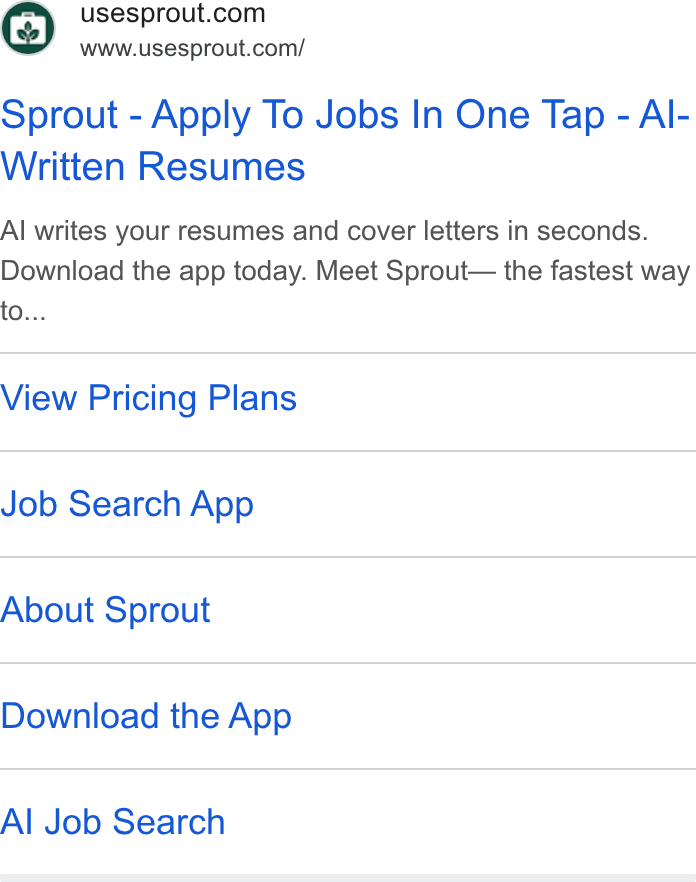
- usesprout.com www.usesprout.com/ Sprout - Apply To Jobs In One Tap - Al- Written Resumes
- CTA / offer
- Download the app today.
- Audience
- Individuals actively seeking jobs or looking to streamline their job application process, indicated by the phrases "Apply To Jobs" and "AI writes your resumes and cover letters."
Why it works. Addresses both the application step and the resume-writing step in a single headline instead of picking just one.
Headline stating a clear benefit and mechanism: "Sprout - Apply To Jobs In One Tap - Al-Written Resumes" If your product solves two adjacent pains, name both explicitly in one headline instead of picking just one.
- Running
- 36 days (longevity = it's converting)
- Hook
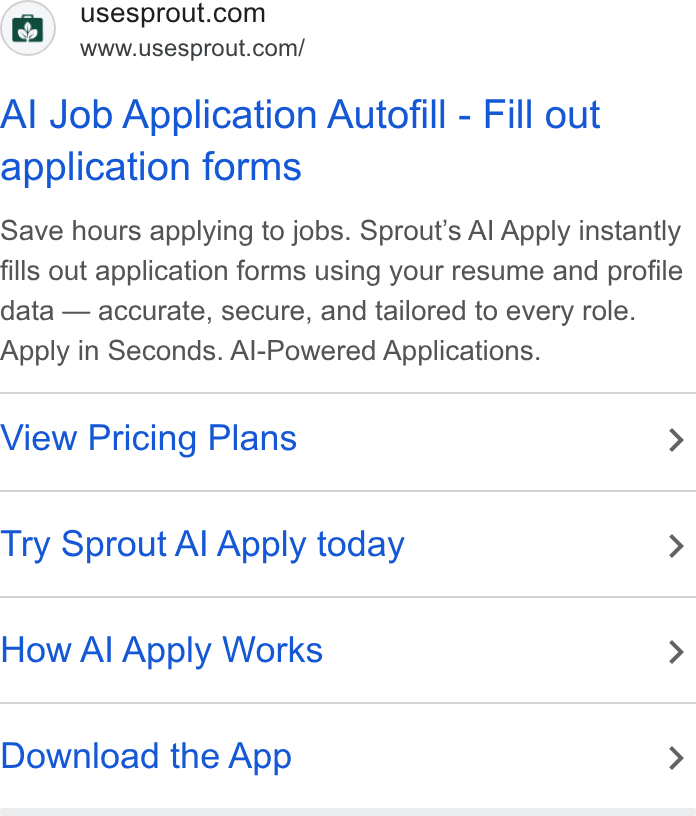
- usesprout.com www.usesprout.com/ AI Job Application Autofill - Fill out application forms
- Audience
- Job seekers who are overwhelmed by the application process, indicated by the focus on 'AI Job Application Autofill' and 'Save hours applying to jobs'.
Why it works. Speaks to anyone who has retyped the same work history for the tenth time, naming the exact task the tool removes.
Headline directly addresses a pain point and offers a solution: "AI Job Application Autofill - Fill out application forms". Describe the tedious manual step your product removes in plain, literal terms instead of an abstract benefit word.
08 The playbook
The channels are not separate. They are one system where each stage feeds the next. Here is the read, then the plays to run tomorrow.
The inferred playbook
Sprout's acquisition loop starts with a filmable product mechanic, converts creator-driven awareness into branded search and referral traffic, and layers Google ads as a demand-capture surface on top of the organic flywheel.
The swipe-to-apply UX required zero production value to demonstrate; creators posted screen recordings of live applications in a single take, and that low creative barrier explains why spontaneous UGC reached a scale that made "sprout jobs" a top-ranked branded search term before the brand formalized an affiliate program.
The referral mechanic (shares unlock free swiping access) lowered the trial barrier on a fully paid pricing stack: the entry plan is $19.99/mo for 80 applications, but a user who refers a friend gets product exposure before paying, surfacing the core loop and raising conversion probability.
Dig deeper+3▾
Google paid search at 5.7% and organic search at 43.9% together represent the bottom of the funnel the TikTok flywheel feeds; the branded queries Sprout ranks at position #1 exist because TikTok built the brand awareness that made people search for the product by name.
The comparison-page cluster covers only two named competitors out of a crowded field; Simplify.jobs, LinkedIn, Indeed, and ZipRecruiter all appear as traffic neighbors with no dedicated comparison pages in the evidence, representing measurable organic and paid opportunity the content engine has not yet addressed.
free-to-paid conversion rate, churn, CAC.
Make the product the creative
The proofSprout's swipe-to-apply mechanic is demonstrable in a 20-second screen recording; creators posted live application demos that generated an estimated hundreds of millions of monthly views without the brand producing any of the content.
The adaptationIdentify the single most visual moment in your product - the first output it generates, the transformation it reveals, the before-and-after it shows - and seed that moment with 5-10 creators in your niche who already post about the problem your product solves. Pitch each a unique discount code and one sentence of framing: "show what happens the first time you use it." Start by listing creators with 10,000-100,000 followers who post about the core pain your product addresses, then offer a free account plus a unique code tied to a trackable affiliate link. The mechanism is that a product demo in context reads as a testimonial, which outperforms a scripted ad for audiences primed to skip sponsored content.
Cost: $0 · Time to signal: weeks · Works pre-PMF: conditional (the first-use moment must produce a visible, filmable reaction; products that require extended onboarding before delivering value will not translate to this format)
Gate a feature on a referral, not a paywall
The proofSprout's referral program unlocks free swiping access for users who refer others; the reward is product access rather than cash, so every referred user arrives with a built-in reason to experience the core mechanic before deciding whether to pay $19.99/mo.
The adaptationPick one capability or usage allowance that your trial or entry-level users want but cannot reach, and wire a share link that unlocks it after one confirmed referral. The key is choosing a gate that genuinely motivates the non-paying user: audit which feature generates the most upgrade requests in your support queue, then build the referral condition around exactly that capability. Start by pulling your top three support or sales objections from unpaid users and ranking which feature resolves each one.
Cost: under $500 one-time (to add the unlock condition) · Time to signal: weeks · Works pre-PMF: yes, provided the gated feature is something non-paying users actively want
Write competitor reviews that serve two masters
The proofSprout's "Teal Review: Features, Pros, and Cons" (URL slug: teal-review-pricing-alternatives) and "Mercor Review: Pros, Cons, and Alternatives" blog posts earn organic visits from competitor-shopping queries AND serve as Google ad destinations; the same URL earns traffic on two timelines from one piece of content.
The adaptationWrite one honest, structured review of a direct competitor your audience is already evaluating, published on your own domain under a "[Competitor] Review: Pros, Cons, and Alternatives" title. Then run a Google search ad targeting "[competitor] alternatives" and "[competitor] review" searchers pointing to that same page. First step: confirm your target competitor registers search volume for their name (which means active comparison shoppers exist to capture), then write the post with a genuine head-to-head comparison and a clear "why you might choose us instead" section. The dual-use structure means one piece of content earns on an organic timeline and a paid timeline simultaneously.
Cost: $0 for content, under $500/mo for the search campaign · Time to signal: weeks for paid, months for organic · Works pre-PMF: conditional (requires a credible named competitor your target audience already recognizes by name)
Intercept your audience at their transition moment
The proofSprout's two highest-traffic blog posts cover summa cum laude and magna cum laude requirements, milestone content that plants the brand among graduating students weeks before they start searching for job apps, with a path from "what does this honor mean for my career?" to a $19.99/mo signup.
The adaptationMap the 2-3 life or work transitions your ideal customer goes through in the 60 days before they would search for a product like yours, then create content targeting what they are searching for at that transition - the milestone question, not the solution query. Start by listing the questions your ICP asks just before purchase intent crystallizes, write one post answering the earliest of those questions, and include a natural bridge to the problem your product solves at the end.
Cost: $0 · Time to signal: months · Works pre-PMF: yes
Preserve your old name as a second search identity through a rebrand
The proofSprout's rename from Prep.ai to Sprout created two addressable search identities: at least one Google ad still runs under "Prep AI - Apply to Jobs Instantly," and both "prep ai jobs" and "sprout job app" rank at position #1, giving Sprout position-one coverage under two brand names at once.
The adaptationIf your product has a prior name or brand iteration, keep the old name indexed and findable rather than 301-redirecting everything to the new brand on day one. Run a single Google text ad under the old name for users still searching for it, pointing directly to your new product. First step: pull the monthly search volume for your old brand name; if the term registers any queries at all, an old-name ad group at branded CPCs pays for itself quickly. Build new branded content from your current homepage simultaneously, so both identities compound over the same period.
Cost: under $500/mo to maintain the old-name ad group · Time to signal: weeks · Works pre-PMF: conditional (requires a prior brand name with residual search volume; a first-time launch has no prior identity to draw on) Not transferable at an earlier stage: the hundreds-of-millions monthly UGC view figure assumes a creator affiliate network already running at scale with dozens of creators posting consistently across platforms. A founder with no existing creator relationships and no affiliate infrastructure cannot replicate that flywheel in weeks. The Google search-harvest strategy of 20 active ads efficiently capturing branded demand also presupposes months of TikTok-driven awareness that made those branded terms worth bidding on. Plays 1 through 4 transfer cleanly to any revenue stage; Play 5 requires a prior brand identity with measurable residual search volume.
You just read how Sprout (formerly Prep.ai) does it. Tomorrow it is someone else.
Every morning we take one company that is actually growing and break down where its customers come from: the ads still running after a year, the channel doing the real work, and the play you can run this week.
Systemaic · directional intelligence. Traffic, spend, and reach figures are SimilarWeb-style estimates and qualitative reads of public data, not audited numbers. Built on real public receipts.
// teardowns with a similar GTM motion
sources & receipts (1)
Live ad libraries: google ad library
Traffic, spend, and revenue figures are estimates as noted in the report; the links above are the primary public artifacts.