- 01Live where your buyer troubleshoots
- 02Turn your data exhaust into a free tool
- 03Contribute inside the ecosystem you sell into
- 04Price the entry tier for one admin, not a committee
01 Snapshot
The one-glance read on who they are and how they grow. Each point is verifiable from the receipts above.
Automated packaging and deployment software for Win32 and macOS apps inside Microsoft Intune (Microsoft's device-management platform), used by 1,000+ IT teams and MSPs (managed service providers).
Community-led, with founder-driven earned media layered on top.
~19,493 monthly visits (down 15.6% over the last 3 months), 2 active Google search ads as of 2026-07-19, and 800+ pull requests from Pckgr's own bot into Microsoft's public Winget package repository.
In a Starter Story feature, the founder frames the business bluntly: "To the outside world, it's really boring... but it makes $60K a month."
Pckgr's edge isn't content volume or ad spend, it's embedding its own bot inside the open-source repository its buyers already depend on, turning ecosystem infrastructure into a trust signal no landing page can replicate.
02 How it unfolded
The order the channels came online. Sequence is strategy: what they did first, and what they layered on once demand existed.
03 Traffic & channel mix
Estimated demand, the channel split behind it, and the keywords and referrers doing the work. Directional modeling, not audited analytics.
Top search keywords
| Keyword | Volume | Weight | CPC |
|---|---|---|---|
| pckgr | 790 | $5.12 | |
| pckgr intune | 110 | - | |
| intune pckgr | 60 | - | |
| nps intune macos | 170 | - | |
| packgr | 50 | - |
Closest competitors by audience
Pckgr draws an estimated ~19,493 monthly visits across all channels, down 15.6% over the last 3 months. A full channel-by-channel percentage split wasn't captured in this pull, so the strongest read comes from what people search for and who else shows up next to them. The top query is their own name, "pckgr" at 790 searches/month, well ahead of "nps intune macos" (170/month) and the branded variants "pckgr intune" (110/month) and "intune pckgr" (60/month), meaning most of the demand they're chasing is people who already know the product exists. On competitors, patchmypc.com is the closest incumbent, explicitly used as the benchmark in a G2 review that flags Pckgr's one functional gap (Entra ID group handling). pdq.com and masterpackager.com round out the set, both surfacing in an independent sysadmin blogger's comparison of cloud-native app-packaging tools, a sign this category still has entrenched, well-known alternatives despite Pckgr's newer pitch.
04 Organic content
The specific pages earning their organic search traffic, and the pattern behind why they rank. Adapt the format, not the topic.
Pckgr's organic traffic is concentrated almost entirely on two assets: the homepage itself carries 87.2% of organic visits, and a single blog post announcing Wingetly (a free Winget search tool) carries another 10.3%, with the docs subdomain pulling effectively none. The ranking pattern backs this up: they sit at #1 for "pckgr," #2 for "intune packager," and #3 for "intune app packaging tool," meaning the SEO motion wins on brand and near-brand category terms rather than a wide blog library. That's a low-volume-content, high-intent-capture strategy: instead of manufacturing new demand, the site is built to convert the search traffic of people who already know Intune packaging is a problem and are typing the category name or the product name directly.
Top pages by organic traffic
05 Channel map
Not traffic share. How much weight the growth system actually puts on each channel, with a one-line read on the role it plays.
What drove growth
06 The motions doing the work
For founder-led SaaS the breakdown shifts from ads to traction: where the first users came from, how the founder grows it in the open, and the compounding organic surface.
Pckgr's first users came through a give-it-away-and-listen Reddit motion inside one niche community, not a big-bang multi-platform launch.
the founder's own origin story, as narrated in Pckgr's Starter Story feature, credits posting the tool on Reddit for free and iterating on user feedback as the earliest acquisition channel, and a real r/Intune thread from 2024-06-28 shows a user discovering "intunepckgr" while troubleshooting an Adobe Creative Cloud deployment for a 20-device fleet.
the company's own "Introducing Pckgr" blog post in May 2023 served as its formal public launch, with product expansion (macOS support that September, Custom Applications that October) following as steady increments rather than a single traction spike.
Dig deeper+1▾
a second r/Intune thread from mid-2024 shows a user troubleshooting apps that stopped deploying after a Windows reimage, evidence real IT admins were running Pckgr in production within its first year, not just browsing the marketing site.
The founder doesn't run a visible personal build-in-public account in the evidence gathered here; instead, Pckgr's most public moments come from third-party earned coverage and a technical blog that doubles as a public changelog.
Starter Story's own Instagram account, not Pckgr's, carried the founder's revenue story to its audience, with reels captioned "$60K MRR solopreneur" pulling 389 and 172 engagements by leaning into a "boring business, real money" angle.
the company blog documents feature ships on a running cadence, from the macOS beta in September 2024 through the Security Dashboard going live in February 2026 and a Custom Applications rebuild in June 2026, giving prospects a visible product-velocity signal without a personal founder feed.
Dig deeper+1▾
users posting deployment problems by name in r/Intune (noted above) function as public, unsolicited testimony that the tool is actively used, which is closer to how prospects actually encounter the brand than any post Pckgr authored itself.
Pckgr's organic footprint is small in absolute terms but concentrated in the highest-intent place possible: its own homepage and near-brand category terms, with a free companion tool acting as a secondary surface.
ranking #1 for "pckgr" and #2-3 for the "intune packager" family of terms (the pattern covered in Organic Content above) means the SEO motion wins searches from people who already know the category or the name, not a blog library manufacturing new demand.
launching Wingetly, a free, hourly-refreshed search tool over the public winget-pkgs repository, in May 2026 gave Pckgr a second entry point built on the same open data asset its Winget bot already touches, compounding two efforts into one flywheel.
Dig deeper+2▾
the 800+ pull requests into Microsoft's own repository (covered in Where They Show Up) work less like marketing copy and more like ambient credibility, planting the name inside a community its exact buyers already monitor.
the 2 active Google ads as of 2026-07-19 bid on both the bare brand term and category phrases like "Intune App Management Software," reading as brand protection layered with light category capture rather than a scaled acquisition program.
07 Paid ads
This founder-led SaaS also runs paid acquisition. Here are the live ads doing the work, each with the X-ray and a play you can adapt.
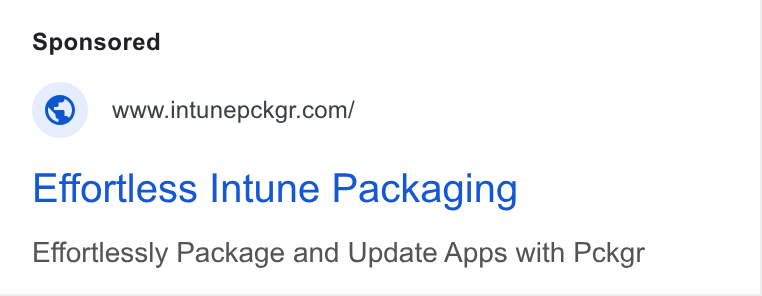
- Running
- 1077 days (longevity = it's converting)
- Hook
- Visual: The word "Sponsored" at the top left, followed by a globe icon and the URL "www.intunepckgr.com/". Text: "Effortless Intune Packaging" below the URL.
- Audience
- IT professionals or system administrators who manage application deployment and updates, indicated by terms like "Intune Packaging" and "Package and Update Apps".
Why it works. Direct response ad using a clear value proposition and benefit-driven headline to attract IT professionals seeking easier application management.
Headline stating a key benefit: "Effortless Intune Packaging" Identify the single biggest pain point your target audience faces and craft a headline that directly promises an 'effortless' or 'simple' solution to that problem.
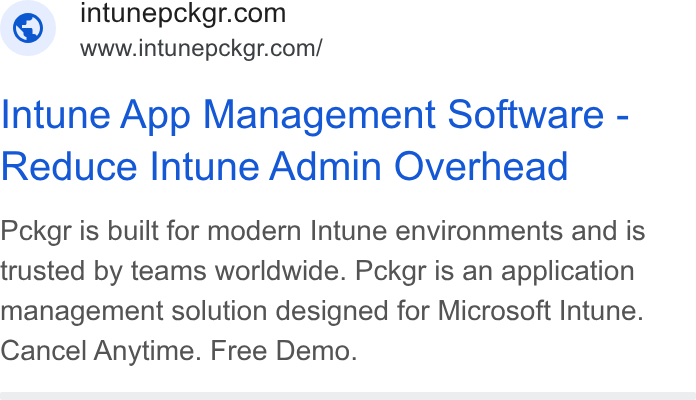
- Running
- 116 days (longevity = it's converting)
- Hook
- Visual: A globe icon next to the text "intunepckgr.com" and "www.intunepckgr.com/". Text: "Intune App Management Software - Reduce Intune Admin Overhead"
- CTA / offer
- Free Demo. Cancel Anytime.
- Audience
- IT administrators or teams managing Microsoft Intune environments, indicated by terms like "Intune App Management Software," "Intune Admin Overhead," and "Microsoft Intune."
Why it works. Direct response ad using problem/solution framing and social proof to drive demo sign-ups for an IT management tool.
Headline directly addresses a pain point and offers a solution: "Intune App Management Software - Reduce Intune Admin Overhead" Identify the single biggest pain point your target audience faces and craft a headline that directly names it and positions your product as the solution.
08 The playbook
The channels are not separate. They are one system where each stage feeds the next. Here is the read, then the plays to run tomorrow.
The inferred playbook
Pckgr's loop starts inside the Winget and Intune admin community itself, converts through a low-friction card-gated trial, and compounds through steady public feature shipping rather than any single acquisition channel.
organic discovery inside sysadmin community spaces (r/Intune threads, G2 comparisons, independent blogger reviews) plus the Winget bot's presence in Microsoft's own repository, not brand advertising.
a 30-day free trial that requires payment details up front, paired with device-count tiers running $49 to $149 a month, that let a single IT admin self-serve into the Starter plan without a procurement process.
Dig deeper+3▾
the blog's public shipping cadence and the Wingetly utility both sit on the same Winget data asset the bot already touches, so each new integration adds to a discovery surface that outlives any single post.
there's no visible affiliate, partner, or MSP-referral program, a notable gap given a meaningful share of its 1,000+ customers are agencies managing multiple client tenants who could plausibly refer peers.
trial-to-paid conversion off the 30-day free trial, how often customers expand across the 100/1,000/2,500-device tier breakpoints, and any MSP-to-MSP referral rate given how many of its customers are agencies running multiple client tenants.
Live where your buyer troubleshoots
The proofreal r/Intune threads (the Adobe Creative Cloud deployment struggle, the post-reimage deployment failure) show IT admins discovering and discussing Pckgr organically inside one niche subreddit, not through a keyword-content library.
The adaptationfind the one subreddit or forum where your buyer already posts support questions, then spend your first sessions there answering the actual troubleshooting threads by name-checking your product only where it solves the stated problem, mirroring how real users surfaced Pckgr while debugging their own Intune deployments.
Cost: $0 · Time to signal: weeks · Works pre-PMF: yes
Turn your data exhaust into a free tool
The proofPckgr built Wingetly, a free search tool over the same public Winget repository its bot already crawls, giving it a second organic entry point without new data-collection work.
The adaptationlook at the data your product already indexes or generates as a byproduct (API responses, scraped inventories, aggregated logs), strip out a narrow, free, no-signup lookup tool from it, and publish it on its own page so it can rank and get shared independently of your paid product, the way Wingetly rides the same dataset Pckgr's bot already touches.
Cost: under $500 · Time to signal: weeks · Works pre-PMF: yes, provided you already have a data asset worth exposing
Contribute inside the ecosystem you sell into
The proofPckgr's bot has landed 800+ pull requests into Microsoft's own public Winget repository, planting its name inside the commit history of the exact tool its buyers already use.
The adaptationidentify the open-source project, package registry, or public directory your buyer already trusts, then automate a genuinely useful, ongoing contribution to it (package updates, documentation fixes, integration PRs) under a recognizable account, so your name accumulates inside a credibility surface you don't own, the same way Pckgr's PRs sit inside Microsoft's repository rather than its own blog.
Cost: under $5k · Time to signal: months · Works pre-PMF: conditional, only if a genuinely relevant open ecosystem exists for your category
Price the entry tier for one admin, not a committee
The proofPckgr's $49/month Starter plan caps at 100 devices and needs no multi-tenant setup, letting a single IT admin swipe a card without procurement.
The adaptationset your lowest paid tier's price and usage ceiling at what one individual or small team would actually hit, translating Pckgr's device-count cap into whatever unit bounds usage in your category, so the first sale never needs a buying committee.
Cost: $0 · Time to signal: weeks · Works pre-PMF: yes
Let a third party tell your revenue number
The proofStarter Story's own Instagram account, not Pckgr's, posted reels captioned "$60K MRR solopreneur" that pulled 389 and 172 engagements by narrating the founder's revenue milestone in a "boring business, real money" angle.
The adaptationpitch your own real revenue milestone to a newsletter, podcast, or creator whose audience already likes ordinary-founder stories, leading with the specific hook of an unglamorous category quietly making real money, since a third party retelling your number carries more credibility than posting it yourself.
Cost: $0 · Time to signal: months · Works pre-PMF: no, needs a real revenue number worth featuring Not transferable at an earlier stage: the open-source bot contribution and the earned-media revenue pitch both depend on already having a working product with real numbers or a mature integration to automate, so a reader without either should start with the Reddit and pricing plays and grow into the ecosystem and press plays once there's a genuine milestone or dataset to point to.
You just read how Pckgr does it. Tomorrow it is someone else.
Every morning we take one company that is actually growing and break down where its customers come from: the ads still running after a year, the channel doing the real work, and the play you can run this week.
Systemaic · directional intelligence. Traffic, spend, and reach figures are SimilarWeb-style estimates and qualitative reads of public data, not audited numbers. Built on real public receipts.
// teardowns with a similar GTM motion
sources & receipts (20)
Live ad libraries: google ad library
Researched facts: Founding story: built by former managed-IT engineers frustrated with manual Intune app pac · Company self-description / origin tagline: "Aussie-made, globally used" — built to take th · CEO / founder name: Thomas Mahony, Chief Executive Officer at Pckgr · Company size: 2-10 employees, headquartered in Melbourne, Victoria; industry listed as Tec · Public launch timeline signal: Pckgr's X/Twitter account (@IntunePckgr) joined March 2022; · Starter pricing plan: $49/month or $499/year, up to 100 devices, access to 1000+ tested ap · Free trial offer: 30-day free trial available, requires entering payment details in the Bi · G2 customer rating for the product: 'Pckgr for Intune' holds a 4.5/5 rating from 11 review · Winget ecosystem contribution / partnership signal with Microsoft's open-source Winget rep · New product launch: Wingetly (Winget search tool): Pckgr launched Wingetly, a search tool
Milestone sources: 2024-09-19: Pckgr expands beyond Windows, launching macOS application deployment support i · 2024-10-30: Pckgr launches Custom Applications, a drag-and-drop tool for packaging and dep · 2025-02-13: Pckgr launches the Pilot Group feature, letting IT admins stage Intune applica · 2026-01-07: Pckgr demonstrates patching vulnerable apps using Microsoft Defender for Endpo · 2026-02-10: Pckgr's Security Dashboard goes live, bringing Microsoft Defender vulnerabilit · 2026-04-21: Pckgr launches Pckgr Portal in public beta, a standalone lightweight/affordabl · 2026-06-17: Pckgr ships Custom Applications 2.0, a major rebuild adding automatic redeploy
Community threads: Independent blog (Stefan Konijnenberg): Independent blogger Stefan Konijnenberg's review h · Independent blog (andrewstaylor.com): Sysadmin blogger Andrew Taylor's package-manager com
Traffic, spend, and revenue figures are estimates as noted in the report; the links above are the primary public artifacts.