- 01Cap the free tier, don't just raise prices
- 02One landing page per use case, not one big pitch
- 03Retarget the locked-feature moment, not the homepage visitor
- 04Seed the tool into non-English creator communities
01 Snapshot
The one-glance read on who they are and how they grow. Each point is verifiable from the receipts above.
A web-based AI mockup generator for designers, e-commerce sellers, and print-on-demand brands, at a founder-reported $100K ARR and $12k+ MRR after launching paid plans in April 2024.
Organic-led: templated SEO landing pages plus the founder's own build-in-public habit compound awareness, with paid social as a paywall-retargeting afterthought.
~350,558 monthly visits, a $100K ARR milestone announced in a June 2025 founder post, and 5 active Meta ads as of 2026-07-30.
Mockey's real lever isn't its ad creative, it's the daily download cap on the free tier that turned casual users into payers and tripled revenue.
02 How it unfolded
The order the channels came online. Sequence is strategy: what they did first, and what they layered on once demand existed.
03 Traffic & channel mix
Estimated demand, the channel split behind it, and the keywords and referrers doing the work. Directional modeling, not audited analytics.
Mockey pulls an estimated 350,558 monthly visits, down 13.5% over the last 3 months. A full channel-mix breakdown (direct/organic/paid split) isn't available, but the ranking keywords tell the acquisition story on their own: the branded term "mockey" and the head term "free mockup generator" both rank #1, while "t shirt mockup" and "mockup generator" rank #3. Ranking on the brand name and the generic category term at once means search is doing most of the top-of-funnel work, not a paid or social push. No referrer or competitor list is available for this profile.
04 Organic content
The specific pages earning their organic search traffic, and the pattern behind why they rank. Adapt the format, not the topic.
Mockey's organic traffic concentrates on a small set of templated product-type pages rather than blog posts: the homepage, a general mockups hub, and individual pages for t-shirt, poster, and hoodie mockups each carry their own share of the tracked organic-search visits. The pattern is a programmatic category structure, one URL per product type under /mockups/, that lets each page target its own specific search term (the t-shirt page ranks #3 for "t shirt mockup") while the homepage and hub carry the branded and generic head terms. It's a replicate-per-category SEO play: every new product type Mockey adds to its mockup library becomes a new indexable page and a new keyword target, compounding without new content production.
Top pages by organic traffic
05 Channel map
Not traffic share. How much weight the growth system actually puts on each channel, with a one-line read on the role it plays.
What drove growth
06 The motions doing the work
For founder-led SaaS the breakdown shifts from ads to traction: where the first users came from, how the founder grows it in the open, and the compounding organic surface.
Mockey's early traction came from an inherited head start, two separate Product Hunt launches, and one friction-removing product change, each documented in the founders' own tweets.
Mockey started in 2021 as a nights-and-weekends feature inside Blinkstore, a print-on-demand platform co-founder Mofid Ansari already ran, and it inherited that site's existing search rankings before spinning out as its own product by late 2023.
The original mockup generator launched on Product Hunt in April 2023, with co-founder Pranay Agarwal tweeting for upvotes alongside Ansari; a later "Mockey AI Pro" launch pulled 115 upvotes and 30 comments as they introduced the paid tier, with a commenter calling Mockey "the only mockup generator that produces stunning results for free."
Dig deeper+2▾
Dropping Google Sign-In on March 15, 2024 removed a signup friction point, and the account hit 10,000 users within three weeks per the founder's own tweet, a bigger jump than either Product Hunt launch produced on its own.
Mockey Pro launched in April 2024, crossed 300 sales by July 2024 per the founder's tweet, and by 2025 the founders were reporting roughly $12k+ MRR (an Indie Hackers post, a startup-founder community and blog) alongside a $100K ARR milestone shared in a June 2025 tweet reading "no funding, no hacks, just consistent building"; the company still cites the two together as concurrent figures (annualized run-rate versus trailing ARR), not a step down.
Founder Pranay Agarwal runs the build-in-public account personally, posting every milestone from the first Product Hunt launch through the $100K ARR mark, while a separate LinkedIn profile actually reaches a bigger audience than his X account does.
Agarwal's personal X profile (169 followers, 276 posts) carries the company's real milestones in his own voice, culminating in the June 2025 post announcing $100K ARR, a small following but a consistent public paper trail.
His LinkedIn profile carries 2,302 followers, far more than the 169 on his personal X account, making LinkedIn the bigger of his two personal channels even though the milestone tweets carry the public detail.
Dig deeper+1▾
Being featured on Indie Hackers, which Agarwal shared via his own tweet on 2025-03-20, extended his reach past his own small following, since the community itself supplied the distribution rather than his personal audience.
Search is Mockey's primary acquisition engine, built on the templated page-per-product-type structure covered above and reinforced by a lightweight affiliate program and a small paid-retargeting layer.
The scalable part of the structure is that every new mockup category the team adds becomes a new page competing for its own search term, without new blog writing required.
A company blog is part of the same system; a March 2024 founder tweet credited improved Google rankings on blog articles with a jump to 500 concurrent site users, a felt traffic spike tied directly to SEO.
Dig deeper+2▾
The site runs a dedicated affiliate/partner program built on Lemon Squeezy (a merchant-of-record payments platform with built-in affiliate tracking), giving outside partners a commission to refer paying users, a distribution lever layered on top of search rather than the primary engine.
All 5 of Mockey's active Meta ads as of 2026-07-30 are classified as proven winners, but the oldest is only 9 days old, so "proven" here means working rather than long-tenured. The creative doesn't chase cold prospects, it re-targets users who already hit the free tier's limits, with hooks like "Unlock everything you tapped on" and "You were one click away," mirroring the same download-cap mechanic that drove organic conversion (expanded as Play 3 below).
07 Paid ads
This founder-led SaaS also runs paid acquisition. Here are the live ads doing the work, each with the X-ray and a play you can adapt.
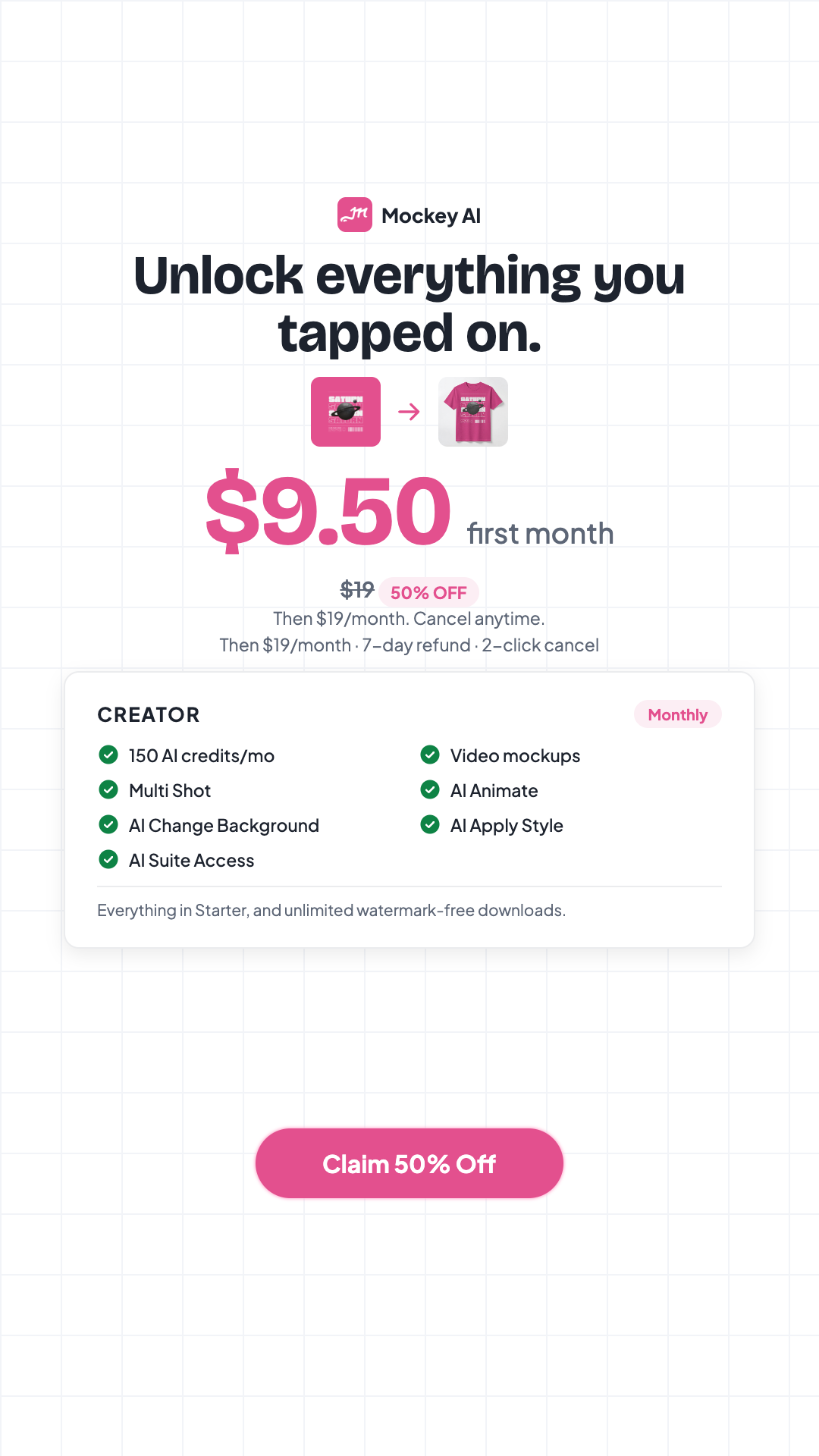
- Running
- 9 days (new — still being tested)
- Hook
- "Unlock everything you tapped on." with a logo for "Mockey AI" and an image showing a black t-shirt design transforming into a pink t-shirt with the same design.
- CTA / offer
- $9.50 first month
- Audience
- The features listed like "150 AI credits/mo", "Multi Shot", "AI Change Background", "Video mockups", "AI Animate", and "AI Apply Style" signal that the target audience is creators, designers, or small businesses who need AI-powered tools for visual content creation and mockups.
Why it works. A direct-response offer with a steep discount on the first month, combined with a clear list of AI-powered features, to convert new users into a monthly subscription.
Prominent discount pricing: "$9.50 first month" with "$19 50% OFF" crossed out. Display a clear, large, discounted price for the first month or trial period, with the original price crossed out and the percentage saved explicitly stated.
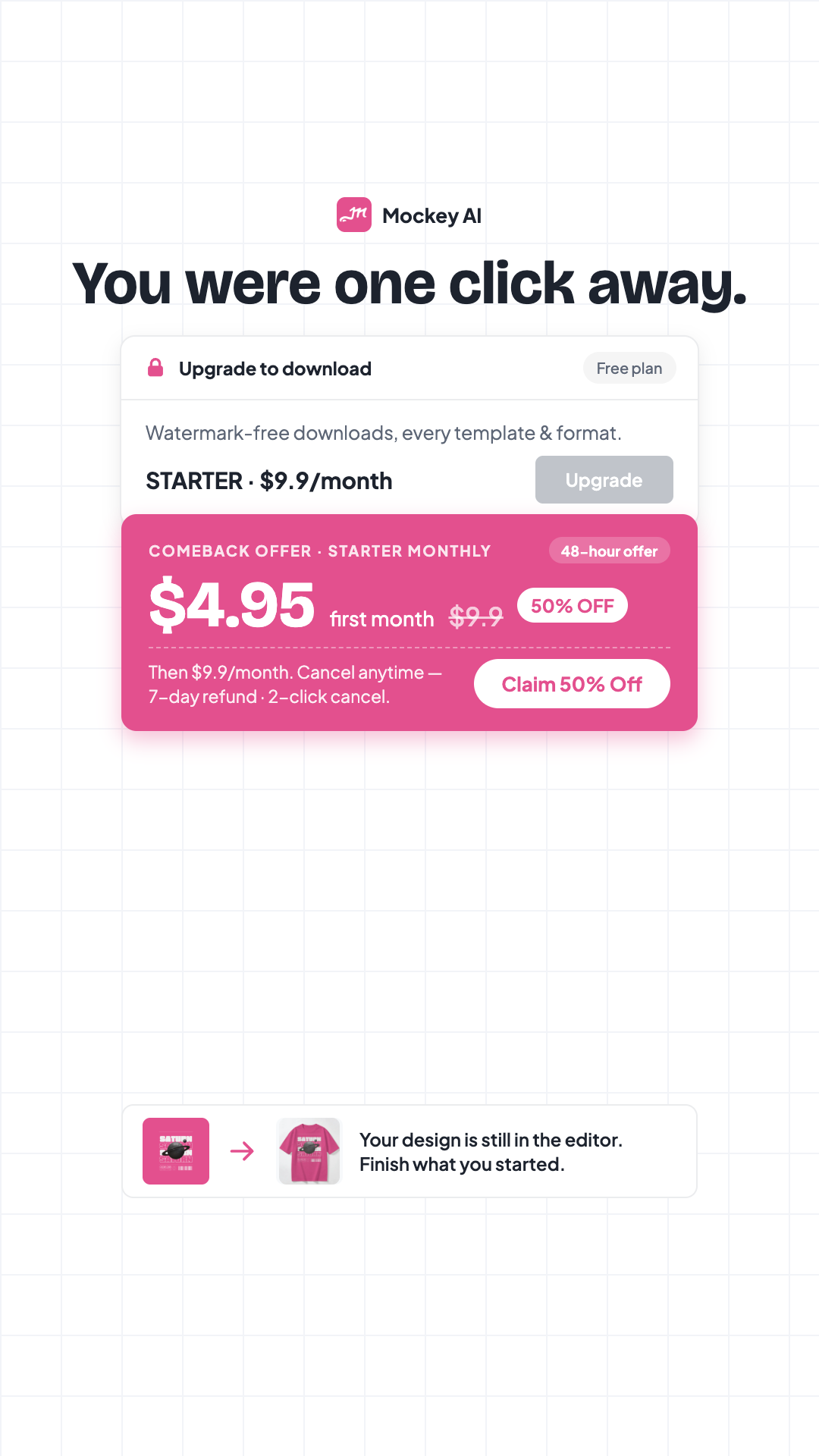
- Running
- 9 days (new — still being tested)
- Hook
- "You were one click away." with a large, bold headline and the Mockey AI logo.
- CTA / offer
- $4.95 for the first month of STARTER MONTHLY, then $9.9/month, with a 7-day refund and 2-click cancel option.
- Audience
- Users who have previously interacted with Mockey AI's editor or free plan, indicated by 'You were one click away.' and 'Your design is still in the editor. Finish what you started.'
Why it works. A retargeting offer with a steep discount and time-bound scarcity to convert users who previously engaged with the product but did not complete a purchase.
Headline stating a missed opportunity: 'You were one click away.' For retargeting, use a headline that directly addresses the user's previous interaction and hints at a missed benefit, e.g., 'Almost there!' or 'Don't leave your cart behind.'
- Running
- 8 days (new — still being tested)
- Hook
- A grid of various product mockups, with a pop-up window in the center displaying "Mockey AI" and "YOU HIT THE PAYWALL".
- CTA / offer
- Claim 50% Off
- Audience
- Creators, designers, and small business owners who use mockups and AI tools, indicated by the 'CREATOR' label and the features listed (video mockups, AI Animate, Multi Shot).
Why it works. A direct paywall conversion strategy using a limited-time discount to convert active users into paying subscribers.
Directly addressing user friction with 'YOU HIT THE PAYWALL' at the top of the pop-up. Identify common points of friction or paywalls in your product and present the subscription offer immediately at that point, acknowledging the user's current state.
08 The playbook
The channels are not separate. They are one system where each stage feeds the next. Here is the read, then the plays to run tomorrow.
The inferred playbook
Mockey's loop runs on search and word-of-mouth pulling users into a generous free tier, a download cap converting the motivated ones, and the founder's own tweets and a bigger community feature supplying trust along the way.
Programmatic mockup pages and organic creator demos across TikTok and Instagram, in five-plus languages, bring in a global, self-selecting designer audience with no formal creator payouts.
The free-tier download cap does the converting, the founders themselves credit it with tripling revenue, and the Meta retargeting ads exist to remind lapsed users of that same locked-feature moment.
Dig deeper+3▾
Every new mockup category becomes both a new SEO page and a new demo opportunity for creators, so the product catalog and the content engine grow together.
There is no visible enterprise or team-seat tier, no named brand customers, and no structured creator-payout program beyond the one Lemon Squeezy affiliate link, so growth still runs through individual self-serve signups rather than any account-based motion.
the free-to-paid conversion rate off the download cap, any revenue figure more recent than the founders' $100K ARR / $12k+ MRR reporting, and how much of the roughly 20K+ monthly signups the founders reportedly cited on Product Hunt (unverified) actually convert to paying plans.
Cap the free tier, don't just raise prices
The proofMockey's free tier used to allow unlimited mockup downloads; adding a simple daily download limit, with no price change, tripled revenue according to the founders' own account.
The adaptationAdd a daily or weekly ceiling to whatever your product gives away unlimited, whether that's exports, generations, or searches, and keep the tier genuinely useful below that ceiling so the wall is felt only by your heaviest users. Start by picking the single action your most active free users repeat daily, cap it just below what a typical daily user needs, and ship it without touching your price page at all.
Cost: $0 · Time to signal: days · Works pre-PMF: yes, provided you already have free users repeating the capped action daily.
One landing page per use case, not one big pitch
The proofMockey's organic search traffic runs through separate pages for the t-shirt, poster, and hoodie mockup categories rather than one generic product page, and the t-shirt page individually ranks for "t shirt mockup."
The adaptationBreak your single product page into one page per specific customer use case or variant, each titled around the exact phrase that use case searches for, and add a new page every time you ship a new variant. Start with the three use cases your current customers mention most often, write one page per use case using their own wording as the title, and publish before building anything else.
Cost: $0 · Time to signal: weeks · Works pre-PMF: yes, since search traffic to each page is itself a validation signal for that use case.
Retarget the locked-feature moment, not the homepage visitor
The proofEvery one of Mockey's active Meta ads targets users who already hit a paywall or tapped a locked feature, with copy like "you were one click away," rather than chasing cold traffic.
The adaptationSet up a retargeting audience keyed to the exact in-app moment someone hits your usage limit or clicks a locked feature, not your general site visitors, and write ad copy that names that specific moment back to them. Start by adding a tracking event on your paywall click, then run a small retargeting budget against just that audience once you have a few hundred hits a month.
Cost: under $500 · Time to signal: weeks · Works pre-PMF: no, it requires existing product usage and a paywall event to target against.
Seed the tool into non-English creator communities
The proofMockey shows up in organic creator demos in Italian, Turkish, Persian, Arabic, and Spanish, spreading through designer communities with no formal payout, one Italian post alone pulling roughly 5,800 engagements.
The adaptationIdentify design or niche creators in a language market your competitors ignore, and send five or six of them free access with nothing more than a "make whatever you want" ask. Start with whichever non-English design community already discusses your product category on TikTok or Instagram, since a quick screen-demo clip is cheap to produce and the demand is already there.
Cost: $0 to under $500 · Time to signal: weeks · Works pre-PMF: conditional, it only works if the product is visually demoable in under 30 seconds.
Pitch your milestone to a bigger community than your own
The proofA feature on Indie Hackers gave the founder more reach than his own 169-follower X account produced on its own.
The adaptationWhen you hit a real number worth sharing, first dollar, first 100 users, a specific revenue milestone, pitch it directly to a community or newsletter with an existing audience in your niche instead of only posting it to your own small following. Start by drafting a three-sentence pitch built around your specific number and sending it to one relevant community's submission address the same day you hit the milestone.
Cost: $0 · Time to signal: days to weeks · Works pre-PMF: no, it requires an actual milestone or number worth pitching. Not transferable at an earlier stage: Mockey's inherited head start, being born inside an existing print-on-demand business with its own audience and search rankings, isn't available to a founder starting from zero. Treat the download-cap, page-per-use-case, and community-pitch plays above as the adaptable core instead.
You just read how Mockey.ai does it. Tomorrow it is someone else.
Every morning we take one company that is actually growing and break down where its customers come from: the ads still running after a year, the channel doing the real work, and the play you can run this week.
Systemaic · directional intelligence. Traffic, spend, and reach figures are SimilarWeb-style estimates and qualitative reads of public data, not audited numbers. Built on real public receipts.
// teardowns with a similar GTM motion
sources & receipts (10)
Live ad libraries: meta ad library
Researched facts: Founders: Mockey.ai (Mockey AI) was founded by Pranay Agarwal and Mofid Ansari. · $12k MRR milestone: Mockey.ai reached ~$12k MRR roughly 11 months after turning on subscri · Subscription pivot date: Mockey pivoted from an ad-only model to a paid subscription model · Funding status — conflicting claims: Tracxn/Crunchbase list Mockey as a seed-stage company · Bootstrapped / team size (alt. metric source): Getlatka profile (interview-style) states M · Template/catalog scale: Mockey.ai's mockup library has grown to 27,000+ templates across 5 · Multi-platform distribution: Beyond the web app, Mockey AI is distributed as a Shopify app · Product Hunt launch: Mockey AI launched on Product Hunt as a free mockup generator for eCo
Community threads: Trustpilot: A Trustpilot reviewer describes a billing accident (three animation renders tr
Traffic, spend, and revenue figures are estimates as noted in the report; the links above are the primary public artifacts.