- 01Open-source the reusable part of your build
- 02Treat your first launch post as a draft
- 03Recruit one named practitioner for a vertical push
- 04Build one landing page per named use case
01 Snapshot
The one-glance read on who they are and how they grow. Each point is verifiable from the receipts above.
An AI creative suite (image, video, 3D generation, editing, upscaling) for individual creators and design teams, monetized through freemium credit-based subscriptions.
Organic-led, compounding off recurring open-weight model launches that break onto Hacker News rather than sustained paid acquisition.
~4.1M monthly visits as of 2026-07-10, 195,314 Instagram followers, and $83M raised at a ~$500M valuation as of its April 2025 Series B (TechCrunch).
As of 2026-07-10, a new paid-search buyer entity (Xun Meng International Limited) is running fresh Krea search ads alongside its usual Midjourney- and Runway-conquesting copy.
Krea's distribution engine is its research output: shipping genuinely open-weight foundation models (Krea 2 pulled 415 Hacker News points) turns each release into free technical-audience reach, not just a product update.
02 How it unfolded
The order the channels came online. Sequence is strategy: what they did first, and what they layered on once demand existed.
03 Traffic & channel mix
Estimated demand, the channel split behind it, and the keywords and referrers doing the work. Directional modeling, not audited analytics.
Traffic sources
Top search keywords
| Keyword | Volume | Weight | CPC |
|---|---|---|---|
| krea ai | 138k | $0.35 | |
| krea | 102k | $0.48 | |
| krea 2 | 32k | - | |
| image enhancer | 408k | $0.22 | |
| image quality enhancer | 106k | $0.21 |
Top referring sites
Closest competitors by audience
Krea pulls roughly 4.1M monthly visits, down 8.8% over the last three months as of 2026-07-10, a real but not alarming pullback for a company that has never leaned on paid acquisition to begin with. Traffic splits across three dominant channels: Direct at 49.4%, unusually high for a company that only started bidding on search, consistent with a tool reopened by the same accounts rather than rediscovered each session; Search Organic at 33.9%, anchored by its SEO-optimized utility pages; and Social Organic at 7.2%, the creator-UGC ecosystem on TikTok and Instagram spilling into direct app visits. The rest, referrals, Gen AI referrals, email, display ads, and paid search, totals under 10% combined.
Its highest-volume ranking terms are generic rather than branded: image enhancer pulls 408,250 monthly searches and image quality enhancer another 105,810, both well above the 137,660 searches for the branded term "krea ai," meaning most of its search-organic share comes from competing on category intent, not name recall. Its referrer mix is unusual for a Western AI tool: vk.ru, a Russian social network, suggests an active Russian-language creator base reposting Krea content; toolify.ai, an AI-tool directory, routes "which AI tool" searchers straight to krea.ai; and gigazine.net, a Japanese tech blog, points to press pickup outside English-language coverage. The closest named competitors, midjourney.com, runwayml.com, and pixelcut.ai, aren't hypothetical: they're the exact brands Krea's own search ads target by name (full breakdown below).
04 Organic content
The specific pages earning their organic search traffic, and the pattern behind why they rank. Adapt the format, not the topic.
Krea's organic footprint runs through a small set of single-purpose utility pages, each built to rank for one high-intent, generic keyword (an image enhancer, an AI hairstyle changer, an image-to-image editor) rather than blog posts or comparison roundups. That is a point-solution SEO pattern: one landing page per discrete AI function lets each page compete on its own for a broad commercial term instead of the pages cannibalizing each other, and it converts search intent directly into a free trial of that specific tool. It ranks well because the intent behind a query like "image enhancer" is transactional (the searcher wants to use one immediately), and a dedicated app page satisfies that intent faster than a generic blog explainer would, then the product's breadth cross-sells once the visitor is inside.
Top pages by organic traffic
05 Channel map
Not traffic share. How much weight the growth system actually puts on each channel, with a one-line read on the role it plays.
What drove growth
06 The motions doing the work
For founder-led SaaS the breakdown shifts from ads to traction: where the first users came from, how the founder grows it in the open, and the compounding organic surface.
Krea's first users arrived through two accidents that predate any campaign, and the company then kept its growth numbers private for nearly three years before publishing a single blog post.
During the 12-week HF0 startup residency in 2022, a post of "AI spirals" on Twitter went viral, an early moment of attention before Krea had a marketing budget or a public launch (Contrary Research).
The team's earliest Hacker News posts show a relaunch pattern rather than one polished debut: a 2023-09-17 submission calling it a tool to "make spiral-like AI art" drew a single point, then two near-identical Show HN posts on the same day, 2023-09-22, framed the same ControlNet feature as "Patterns" and pulled 10 and 8 points respectively, testing which title stuck before the account moved on to the higher-traction technical launches covered above.
Dig deeper+2▾
By 2023-11-14, a submission noting that Microsoft Designer was using Krea's real-time technology to generate images signaled outside adoption without any press push of Krea's own.
Krea didn't publish its first blog post or disclose any user or revenue figures until it paired that disclosure with the Series B announcement detailed above, meaning the bulk of its user growth happened while the company said nothing publicly at all (TechCrunch).
Krea's build-in-public motion runs almost entirely through one person's X account rather than the brand handle, the company account stays quiet on strategy and the founder account carries the voice.
Co-founder and CTO Diego Rodríguez posts from @asciidiego (7,619 followers, 1,084 posts lifetime), and every major ship in the evidence, the open-weight model release, Krea iPad, real-time voice editing, and the first foundation model, has a personal post attached rather than a brand-account announcement.
His posts favor a point of view over a metric: the iPad launch post covered above paired product news with a stance, "Less text-to-anything and more magic pens please!", positioning Krea against prompt-only competitors in the founder's own words rather than in ad copy.
Dig deeper+1▾
Unlike founders who post MRR or user-count updates as a growth tactic, Diego's account carries zero visible revenue or growth-metric posts in the evidence, consistent with the company's pattern of silence until the Series B reveal above, so the build-in-public engine here is about taste and product philosophy, not transparency theater.
Krea invests its organic surface entirely in the point-solution app pages covered above rather than a blog or docs library, and its paid search runs a distinct, aggressive conquesting play on top of that.
Every page driving the 33.9% organic-search share noted in the traffic mix is a working tool page, not an article, meaning the SEO strategy IS the product catalog: each new AI capability doubles as its own landing page instead of feeding a separate content team.
Google ads point to niche destinations built specifically for paid traffic, /marketing/graphic_design, /ads/generator, /music_video/generator, /product/design, and /gaming, a layer of use-case-specific pages separate from the organic app pages, built to match ad intent (a tattoo designer, a game texture artist, a video ad marketer) rather than to rank organically on their own.
Dig deeper+2▾
Of roughly 22 total Google ads as of 2026-07-10 (16 active), the strongest creative bids directly on rival names: "Sora without the hiccups - Higher quality video than Sora" and "Done with Midjourney? - Midjourney with superpowers" pair a curiosity hook (Sora) with a bold-claim hook (Midjourney) to intercept searchers already comparing tools, a demand-capture play rather than demand generation, aimed at users who type a competitor's name into Google.
Roughly 10 LinkedIn ads (4 active as of 2026-07-10) run a webinar offer built around Nitsan Bartov, an architect at Henning Larsen, the same partnership behind the architecture-focused YouTube podcast episode noted in the channel map, an account-based push into one named vertical that runs independently of the consumer-facing Google conquesting.
07 Paid ads
This founder-led SaaS also runs paid acquisition. Here are the live ads doing the work, each with the X-ray and a play you can adapt.
- Running
- 38 days (longevity = it's converting)
- Hook
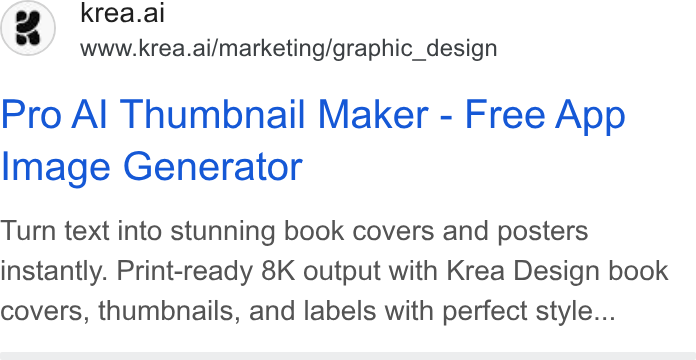
- krea.ai www.krea.ai/marketing/graphic_design Pro AI Thumbnail Maker - Free App Image Generator
- CTA / offer
- Pro AI Thumbnail Maker - Free App Image Generator
- Audience
- Individuals or small businesses needing graphic design tools, indicated by 'Thumbnail Maker', 'Image Generator', 'book covers', 'posters', and 'labels'. The 'Free App' also targets those seeking cost-effective solutions.
Why it works. Targets creators searching for thumbnail tools with a free-app claim, positioning Krea as a no-cost alternative to paid thumbnail software for YouTubers and marketers.
Headline clearly states the product and its core benefit: "Pro AI Thumbnail Maker - Free App Image Generator" Stack your product's core search terms and the free-trial claim directly in the headline so one ad matches several related search queries.
- Running
- 38 days (longevity = it's converting)
- Hook
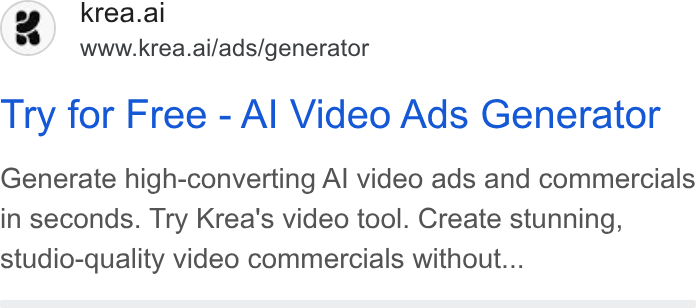
- krea.ai www.krea.ai/ads/generator Try for Free - Al Video Ads Generator
- CTA / offer
- Try for Free - Al Video Ads Generator
- Audience
- Businesses or marketers looking for quick and effective video ad creation, indicated by 'Generate high-converting AI video ads and commercials in seconds'.
Why it works. Targets marketers searching for ad-creation tools with a free trial offer, reducing the barrier for advertisers comparing AI video ad generators.
Lead with a free offer in the headline: "Try for Free - Al Video Ads Generator" Put your free trial offer before your product category in the headline so cost-sensitive searchers click first.
- Running
- 37 days (longevity = it's converting)
- Hook
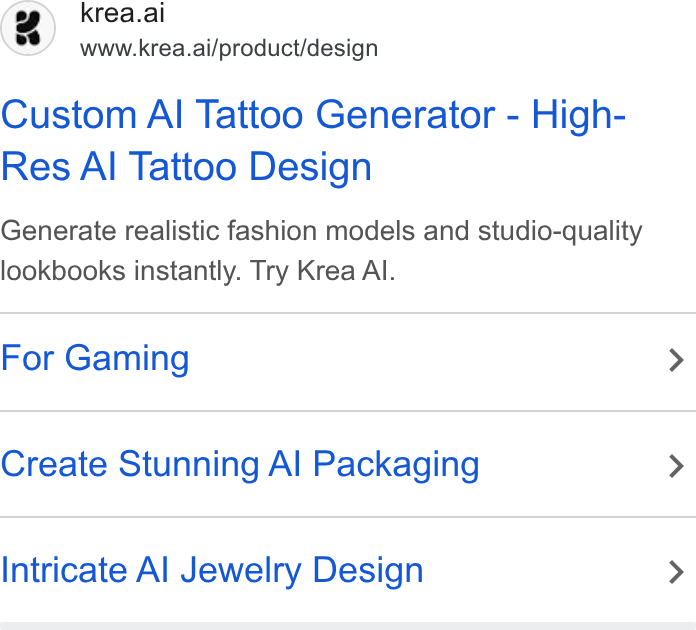
- krea.ai www.krea.ai/product/design Custom AI Tattoo Generator - High-Res AI Tattoo Design
- CTA / offer
- Try Krea AI.
- Audience
- Individuals or businesses involved in design, fashion, gaming, packaging, and jewelry, indicated by the specific AI design tools offered.
Why it works. Targets a specific creative niche (tattoo design) with a quality signal (high-res) to capture searchers who wouldn't respond to a generic AI-image ad.
Headline: 'Custom AI Tattoo Generator - High-Res AI Tattoo Design' Build a landing page and ad headline around one narrow creative niche your broad tool can serve, naming the niche explicitly.
Show 3 more ads

- Running
- 27 days (longevity = it's converting)
- Hook
- krea.ai www.krea.ai/gaming Try for Free - The Ultimate Game Design Al - Instant 3D Texture...
- CTA / offer
- Try for Free
- Audience
- Game designers, 3D artists, or anyone involved in game development, indicated by phrases like "Game Design AI," "game-ready materials," "3D assets," and "seamless textures."
Why it works. Targets a narrow buyer, game designers, with a specific output (3D textures) plus a free trial, filtering for high-intent clicks over broad curiosity seekers.
Headline with a clear offer and bold claim: "Try for Free - The Ultimate Game Design Al - Instant 3D Texture..." Name the exact niche output your tool produces in the headline and pair it with a free trial so only high-intent buyers click.
- Running
- 27 days (longevity = it's converting)
- Hook
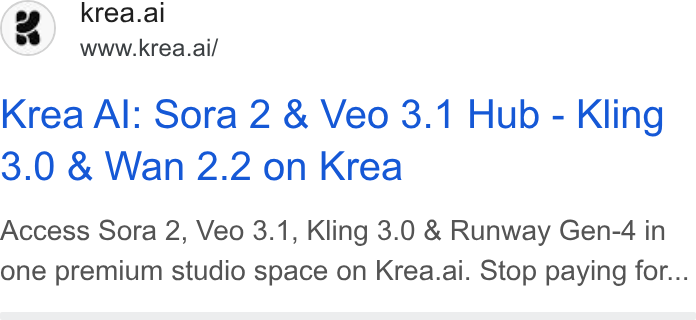
- Visual: A small circular icon with a black, abstract 'K' on a white background, next to the text "krea.ai" and "www.krea.ai/". Below this, the blue headline "Krea AI: Sora 2 & Veo 3.1 Hub - Kling 3.0 & Wan 2.2 on Krea".
- CTA / offer
- Access Sora 2, Veo 3.1, Kling 3.0 & Runway Gen-4 in one premium studio space on Krea.ai. Stop paying for...
- Audience
- Individuals or businesses interested in AI video generation tools like Sora, Veo, Kling, and Runway Gen-4, indicated by the specific product names listed.
Why it works. Lists the exact model names users are already searching for so the ad ranks as the answer to a multi-tool comparison shopper.
Headline lists specific, high-value AI tools: "Krea AI: Sora 2 & Veo 3.1 Hub - Kling 3.0 & Wan 2.2 on Krea" If you bundle access to several known third-party tools, name each one explicitly in your headline instead of describing the category.
- Running
- 27 days (longevity = it's converting)
- Hook
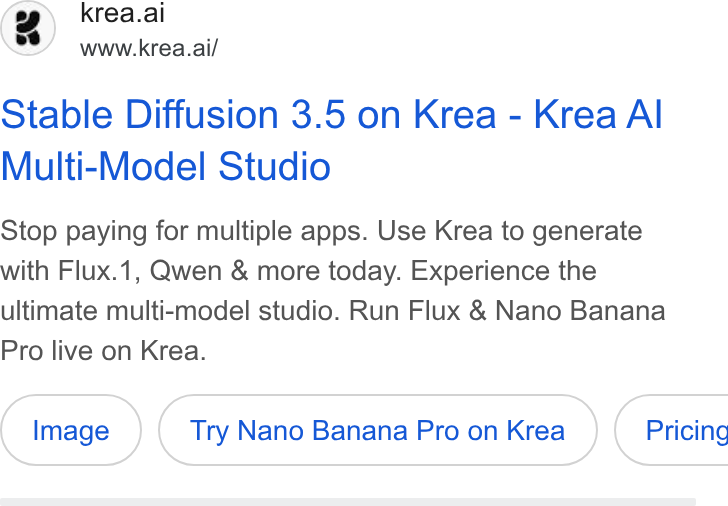
- krea.ai www.krea.ai/ Stable Diffusion 3.5 on Krea - Krea Al Multi-Model Studio
- CTA / offer
- Try Nano Banana Pro on Krea
- Audience
- Individuals or businesses looking for advanced AI model access and multi-app consolidation, evidenced by mentions of 'Stable Diffusion 3.5', 'Multi-Model Studio', 'Flux.1', 'Qwen', and 'Nano Banana Pro'.
Why it works. Captures searchers looking for a specific, newly released model version and positions Krea as the studio that already has it live.
Headline stating a specific, advanced AI model and platform: "Stable Diffusion 3.5 on Krea - Krea Al Multi-Model Studio" The day a hot new model version ships, publish a search ad pairing that exact version number with your platform name.
08 The playbook
The channels are not separate. They are one system where each stage feeds the next. Here is the read, then the plays to run tomorrow.
The inferred playbook
Krea's loop starts with a technical release that earns free attention, routes that attention through point-solution pages built to catch category-level search intent, and converts inside the product itself, with almost nothing holding users once they've entered besides the tool's own quality.
Open-weight model drops and Show HN launches (covered above) generate recurring, unpaid technical-audience reach that a marketing budget cannot buy at the same credibility, and the founder's X account extends each release's life with a personal framing.
The point-solution app pages absorb that attention and search demand directly into product trials, with Google ads layered on top to catch the same comparison-shopping intent for users who arrive via search instead of a launch post.
Dig deeper+3▾
Each new model or feature creates both a new organic landing page and a new open-weight release cycle, so the content surface and the research pipeline grow together rather than requiring a separate content team.
The one visible support channel is Discord, and the sole Reddit thread in the evidence is an unanswered billing complaint, meaning a user who hits friction post-purchase has no clear escalation path, a real leak for a company converting on trust in an AI-tooling category full of scam complaints.
free-to-paid conversion rate, churn, and customer acquisition cost.
Open-source the reusable part of your build
The proofThe open-weight model releases covered above turned an engineering artifact into free technical-audience reach on Hacker News, repeatedly, without a launch budget.
The adaptationWhatever the reader is building, some internal component, a dataset, a fine-tuned model, an eval harness, an internal tool, is likely useful to other builders even if the core product isn't ready to open. Package that one component with a real README and a permissive license, then post it as a Show HN with a title that states exactly what it does and why it's different, not what company it's from. First step: pick the single most reusable thing already built internally and ship it standalone before shipping anything else.
Cost: $0 · Time to signal: days · Works pre-PMF: yes, provided what's released solves a real technical problem rather than functioning as thin marketing.
Treat your first launch post as a draft
The proofThe early Hacker News history above shows the same feature launched under three different framings within days, from a one-point post to two same-day Show HN attempts, before the framing that stuck emerged.
The adaptationDon't wait for the perfect single launch. Write three different one-line framings of the same product before ever posting publicly, ship the cheapest one first as a test, and if it doesn't land, relaunch under a different angle within days rather than waiting months for the "real" launch. First step: draft those three framings now and post the least-precious one to whichever community your users already gather in.
Cost: $0 · Time to signal: days · Works pre-PMF: yes.
Recruit one named practitioner for a vertical push
The proofThe LinkedIn and podcast pairing with an architect at Henning Larsen, covered above, targets one specific professional vertical using a recognizable industry name rather than a generic ad.
The adaptationIdentify the single vertical inside your broader market with the most obvious buying intent, then offer a respected practitioner in that niche a free co-hosted session (a webinar, an AMA, a live demo) in exchange for their name and audience, not payment. Run a small paid push naming them as the draw. First step: message three practitioners in that vertical this way and take whichever says yes first.
Cost: under $500 · Time to signal: weeks · Works pre-PMF: conditional, only if the product is polished enough to demo live and the practitioner's audience overlaps with real buyers.
Build one landing page per named use case
The proofThe vertical ad-landing pages covered above give paid traffic a purpose-built destination for each use case instead of sending every click to the homepage.
The adaptationList the three or four specific jobs different customer segments hire the product for, then build one narrow page per job with its own headline naming that exact use case, and point a small search-ad test at the matching keyword. First step: write the three pages before running any spend, so the ad has somewhere precise to land.
Cost: under $500 · Time to signal: weeks · Works pre-PMF: conditional, yes if the product already genuinely serves that use case.
Post every ship from the founder's own account first
The proofDiego's personal launch posts, covered above, consistently outperform what a brand account alone would generate, and his iPad post's framing shows a distinct point of view rather than boilerplate.
The adaptationWhenever a feature or fix ships, record a short screen capture and post it from the founder's personal account with a one-line opinion about why it matters, before the company account posts the same update. First step: do this for the very next thing shipped, and keep doing it every time after.
Cost: $0 · Time to signal: days · Works pre-PMF: yes. Not transferable at an earlier stage: the open-weights research play assumes there is something technically substantial worth releasing, which most pre-product founders will not have yet, and the vertical webinar play needs both a demo-ready product and a recognizable industry name willing to co-host, neither of which exists on day one. The launch-iteration and founder-voice plays, by contrast, scale down to zero budget immediately and are where a reader with nothing yet should start.
You just read how Krea does it. Tomorrow it is someone else.
Every morning we take one company that is actually growing and break down where its customers come from: the ads still running after a year, the channel doing the real work, and the play you can run this week.
Systemaic · directional intelligence. Traffic, spend, and reach figures are SimilarWeb-style estimates and qualitative reads of public data, not audited numbers. Built on real public receipts.
// teardowns with a similar GTM motion
sources & receipts (8)
Live ad libraries: linkedin ad library · google ad library
Launch archives: Hacker News: Krea Realtime 14B: an open-source real-time video model · Hacker News: Krea 2: SOTA open-weights 12B image model · Hacker News: Fast frame-consistent video models as "world" models · Hacker News: Releasing weights for FLUX.1 Krea · Hacker News: FLUX.1-Krea and the Rise of Opinionated Models · Hacker News: FLUX.1 Krea [Dev]: An 'Opinionated' Text-to-Image Model
Traffic, spend, and revenue figures are estimates as noted in the report; the links above are the primary public artifacts.