- 01Seed a niche forum under a personal account
- 02Personally recruit your skeptics as calibrators
- 03Build one page per exact buyer phrase
- 04Publish your accuracy test as its own page
01 Snapshot
The one-glance read on who they are and how they grow. Each point is verifiable from the receipts above.
An AI teaching assistant that grades student essays and gives feedback for VCE, HSC, QCE, WACE, and IB English classes, sold directly to Australian secondary schools, part of Y Combinator's W25 batch.
Founder-led: direct school partnerships, personal Reddit and LinkedIn outreach, and a YC launch moment, not a paid or creator-driven acquisition motion.
About 19,000 monthly visits (+11.8% over the last three months) as of 2026-07-25, a $600K pre-seed closed 2024-11-01, and an estimated 19 employees as of mid-2026 (per Tracxn, a startup-data platform).
Trust is built one relationship at a time, teacher by teacher and school by school, not one audience at scale, the founder's personal Reddit and LinkedIn outreach is the actual engine behind the modest SEO and ad footprint that surrounds it.
02 How it unfolded
The order the channels came online. Sequence is strategy: what they did first, and what they layered on once demand existed.
03 Traffic & channel mix
Estimated demand, the channel split behind it, and the keywords and referrers doing the work. Directional modeling, not audited analytics.
Traffic sources
Top search keywords
| Keyword | Volume | Weight | CPC |
|---|---|---|---|
| edexia | 3.0k | $3.43 | |
| edexia login | 180 | - | |
| vce english ai | 140 | - | |
| idexia education automatio | 90 | - | |
| hl essay grader | 120 | - |
Closest competitors by audience
Edexia pulls an estimated 19,000 monthly visits, up 11.8% over the last three months as of 2026-07-25. Direct traffic dominates at 51.6%, consistent with a B2B tool where teachers and students already have a bookmarked or school-shared link rather than searching fresh each time. Search Organic is the clear second channel at 30.1%, Referrals sit at 8.3% and Email at 6.9%, and the rest, social organic and Gen AI referrals (visits from AI assistants like ChatGPT and Perplexity), totals under 4%.
The branded term "edexia" pulls 2,960 monthly searches, while "edexia login" (180/mo) points to an existing user base looking for the portal rather than new demand. Category terms like "vce english ai" (140/mo) and "hl essay grader" (120/mo, HL referring to IB Higher Level) show the two curricula segments, VCE and IB, actively searching for what Edexia does. The traffic tool's algorithmic competitor set returns unrelated small sites like designforhackers.com and learnmyway.com rather than any real essay-grading rival, a sign Edexia's footprint is still too niche for the tool to surface a genuine competitive set.
04 Organic content
The specific pages earning their organic search traffic, and the pattern behind why they rank. Adapt the format, not the topic.
Edexia's organic footprint is a lean, five-page surface anchored almost entirely by the homepage, which pulls the large majority of its organic traffic, with the /research, /for-vce-english, and /faq pages doing small supporting work. The pattern is trust and conversion pages, not a blog or listicle content engine: a credibility page, a curriculum-specific landing page, and an FAQ, each built to match a query a buyer would actually type rather than to farm long-tail search volume. That precision shows in the rankings: the site holds the #1 spot for its own brand name plus several generic category terms ("ai essay grader," "ai essay marker," "ai marking essays") and #3 for "essay marker," suggesting the pages are winning on tight relevance to a small set of head terms rather than breadth of content.
Top pages by organic traffic
05 Channel map
Not traffic share. How much weight the growth system actually puts on each channel, with a one-line read on the role it plays.
What drove growth
06 The motions doing the work
For founder-led SaaS the breakdown shifts from ads to traction: where the first users came from, how the founder grows it in the open, and the compounding organic surface.
Edexia's early traction came from direct outreach to individual Australian schools rather than a public launch spike, with the YC W25 stamp layered on top for credibility.
Co-founders Daniel Gibbon (CEO) and Nathan Wang (CTO), both second-time EdTech founders, launched Edexia's grading product on 2024-08-01 and had 11 Australian schools onboarded by Q4 2024, with roughly 30 more partnerships being arranged for Q1 2025.
Gibbon has said the company turned down $2 million offers from two Australian VC firms to join Y Combinator instead, closing a $600K pre-seed on 2024-11-01 shortly before YC publicly listed Edexia in its W25 batch that December.
Dig deeper+2▾
A TikTok clip tagged #yc #startups #ycombinator ran around 2025-02-05, timed to the YC batch window.
More than a year after launch, the founder posted directly into r/vce under a personal handle in March 2026, framing Edexia as a friend's project rather than disclosing it outright, a soft-touch community move rather than a coordinated launch.
Growth here runs through the founders' own outreach rather than a personal-brand posting cadence, Daniel Gibbon persuades individual teachers and students directly, on Reddit, on LinkedIn, and in press.
The founder posted in r/vce under the handle New-Arm1617 in March 2026, offering a free VCE essay check and describing Edexia as a "friend's" project rather than his own company, drawing 11 upvotes and 3 comments, the only subreddit visible in the data.
An IB English teacher wrote on LinkedIn that Gibbon personally reached out and invited her into a small group of experienced IB educators helping calibrate the AI's grading, turning potential skeptics into contributors before they become critics.
Dig deeper+2▾
Rather than a build-in-public feed, Gibbon takes the founder-quote route: he told Business News Australia the company turned down two $2M Australian VC offers for YC, and told an industry newsletter that "We're not here to replace teachers... We're here to empower them" in response to a bias question.
The company's X account (@EdexiaAi) and LinkedIn page are both linked from the homepage, but no post-level activity data is available to say how active either is as a channel.
The SEO motion is small and precise: five pages that mirror exactly what a buyer types, not a content factory built to compound over years.
The organic pattern covered above shows a five-page site winning both its brand term and several generic category queries, and Search Organic accounts for 30.1% of Edexia's ~19,000 monthly visits, the second-largest channel behind direct traffic.
There is no blog, comparison-page cluster, integrations directory, or affiliate program visible in the data, so the SEO win to date looks like well-built product pages rather than a programmatic engine that keeps growing on its own.
Dig deeper+2▾
The /accuracy page turns an independent accuracy trial into its own indexed, linkable page rather than a buried blog post, the kind of asset that doubles as both an SEO page and a sales tool for a skeptical department head.
As of 2026-07-25, 0 of Edexia's 2 total Google ads are active. The two that ran, "We Analyze Your Written Work, Experience AI-Powered Feedback" and "Free Grading App for Teachers," led with a free action and a fast benefit rather than a feature pitch, reading as a short demand-generation test aimed at teacher-search terms rather than a defensive brand-bid campaign, and both stopped by December 2025.
07 Paid ads
This founder-led SaaS also runs paid acquisition. Here are the live ads doing the work, each with the X-ray and a play you can adapt.
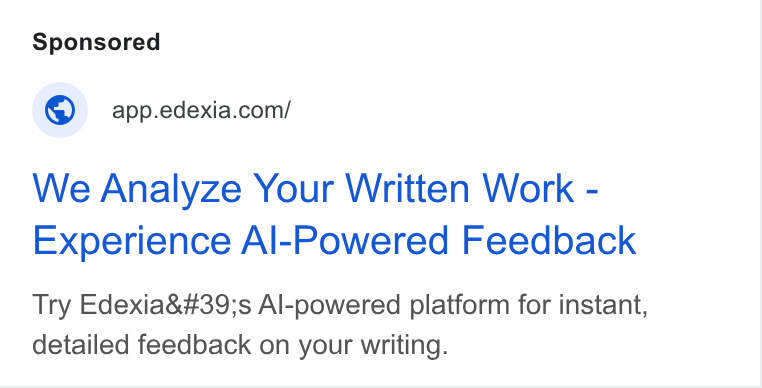
- Running
- 26 days (longevity = it's converting)
- Hook
- Sponsored app.edexia.com/ We Analyze Your Written Work - Experience AI-Powered Feedback
- CTA / offer
- Try Edexia's AI-powered platform for instant, detailed feedback on your writing.
- Audience
- Anyone who writes and needs feedback, indicated by "Your Written Work" and "feedback on your writing."
Why it works. Targets anyone searching for writing feedback with a direct value statement, letting the outcome sell the product before the tech does.
Headline directly addresses a user need: "We Analyze Your Written Work - Experience AI-Powered Feedback" Lead your headline with the deliverable your tool produces, then name the AI mechanism second so benefit precedes buzzword.
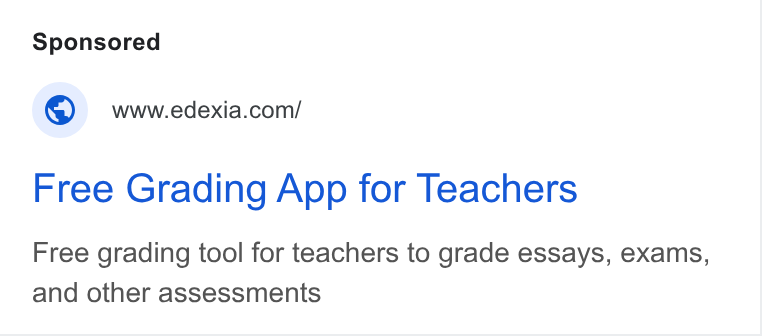
- Running
- 48 days (longevity = it's converting)
- Hook
- Sponsored www.edexia.com/ Free Grading App for Teachers
- Audience
- The text 'Free Grading App for Teachers' and 'Free grading tool for teachers' directly signals that the ad is for educators.
Why it works. Search ad matches teacher-intent queries with a free-tool headline, removing price as a barrier for budget-conscious educators.
Headline with direct benefit: 'Free Grading App for Teachers' Put your price point, free or a dollar figure, and your buyer's job title in the same headline line to pre-qualify clicks.
08 The playbook
The channels are not separate. They are one system where each stage feeds the next. Here is the read, then the plays to run tomorrow.
The inferred playbook
The acquisition loop starts with a direct relationship, converts through a credibility asset, and has no compounding content or paid engine underneath it yet.
Individual outreach and the YC credential do the top-of-funnel work, a school hears about Edexia through a founder conversation or the YC name, not an ad or a viral post.
The /research accuracy trial and flexible per-school pricing, no published tiers, quotes handled directly per Edexia's own FAQ, let a department head build an internal case without ever hitting a self-serve checkout.
Dig deeper+3▾
No content or programmatic SEO surface compounds independently of the founders' own time, and Edexia's own site distinguishes its named schools as "collaborators, not customers," suggesting the roughly 19-person team (Tracxn, mid-2026) is still working accounts by hand rather than a channel doing it for them. No public revenue figures exist; given per-school licensing and team size, a reasonable estimate lands in the low-to-mid six-figure ARR range, not a verified number; note that a ~19-person team is far larger than a $600K pre-seed alone could sustain, implying either meaningful revenue or more funding than the verified figure shows.
Edexia's own profile on EduGrowth (an Australian edtech industry association) states "$6.5 million in funding" and "40+ schools," while Crunchbase and PitchBook show verified funding closer to $500K-$600K, a gap worth flagging for anyone sizing the company off public claims alone.
per-school contract value, the renewal or expansion rate across the school base, and how many of the listed schools are paying customers versus the free-pilot "collaborators" the site itself distinguishes them from.
Seed a niche forum under a personal account
The proofEdexia's founder posted a free VCE essay-checking offer in r/vce under a personal handle, framing it as a tip from "friends" rather than a company post, and it landed 11 upvotes and 3 comments in the exact subreddit where the target students ask for help.
The adaptationFind the one or two forums or subreddits where your exact buyer already asks for help with the problem you solve, then post a genuinely useful free resource tied to your product under a personal account, framed as a recommendation rather than a pitch, matching the friend-not-founder framing that reads as organic. First step: pick the subreddit, read its self-promotion rules, and post one specific free resource, not a company announcement.
Cost: $0 · Time to signal: days · Works pre-PMF: yes, provided you disclose enough to avoid a self-promotion ban.
Personally recruit your skeptics as calibrators
The proofCEO Daniel Gibbon personally messaged an experienced IB English teacher on LinkedIn, inviting her into a small group of educators who help calibrate the grading model, according to her own account of the exchange.
The adaptationIdentify 5-10 named practitioners whose judgment your product needs to get right, not just users but evaluators, and send each a specific, narrow ask: help calibrate a rubric, dataset, or edge case in exchange for early access, turning skeptical experts into invested co-builders instead of cold-outreach targets. First step: build the named list and send a three-sentence personal message referencing each person's specific expertise.
Cost: $0 · Time to signal: weeks · Works pre-PMF: yes.
Build one page per exact buyer phrase
The proofEdexia ranks #1 for "ai essay grader," "ai essay marker," and "ai marking essays" off a five-page site, showing generic category queries can be won without a content factory.
The adaptationList every literal phrase a buyer types right before they'd want your product, tool-plus-verb-plus-noun combinations like "[category] grader" or "[category] checker," and build one clean landing page per phrase with that exact phrase in the H1 and title tag. First step: pull five such phrases from search autocomplete and ship a page for the highest-intent one first.
Cost: under $500 · Time to signal: months · Works pre-PMF: yes, conditional on the product actually doing the specific thing being searched for.
Publish your accuracy test as its own page
The proofEdexia built a dedicated /accuracy page around an independent trial of 579 essays, reporting 81.2% exact grade agreement with teachers and 98.3% agreement within one grade band, rather than burying the number in a blog post.
The adaptationRun a small, honest benchmark against real users or experts in your category, publish the raw method and result on its own URL, and link it from your homepage and pricing page, since a dedicated credibility page converts skeptics that generic testimonials do not. First step: run the test on the smallest sample that is still honest, dozens rather than one, and publish the number even if it is imperfect.
Cost: $0 · Time to signal: weeks · Works pre-PMF: yes, provided the result is genuinely good; publishing a mediocre number will hurt more than help.
Lead your ad or landing page with the free action, not the brand
The proofEdexia's best-performing search ad, live for 48 days before it stopped, was the plain claim "Free Grading App for Teachers" rather than a feature pitch, and its companion ad, "We Analyze Your Written Work," also led with a fast, tangible action. Both of Edexia's Google ads had stopped running by December 2025, so treat the free-action framing as the transferable hook, not evidence of an ongoing campaign to imitate outright.
The adaptationBuild one narrow, genuinely free slice of your paid product, a single-use tool rather than a trial, and make its landing page headline and any low-budget search ad about that free action itself ("Free [verb] for [buyer]"), not your brand name or roadmap. First step: pick the single most-searched task your product does, wrap it in a no-signup free tool, and title the page after that exact task.
Cost: under $500 · Time to signal: weeks · Works pre-PMF: yes. Not transferable at an earlier stage: the YC batch credibility and pre-seed funding that got Edexia's founder-outreach into schools' doors, and the existing pilot relationships needed to run a real accuracy trial in the first place, both require a level of institutional trust a reader without funding or a network won't have on day one. The community-seeding and expert-recruitment plays above do not depend on either.
You just read how Edexia does it. Tomorrow it is someone else.
Every morning we take one company that is actually growing and break down where its customers come from: the ads still running after a year, the channel doing the real work, and the play you can run this week.
Systemaic · directional intelligence. Traffic, spend, and reach figures are SimilarWeb-style estimates and qualitative reads of public data, not audited numbers. Built on real public receipts.
// teardowns with a similar GTM motion
sources & receipts (13)
Live ad libraries: google ad library
Researched facts: Founding story in founders' own words: "We're Daniel and Nathan. We met at university afte · Co-founders and roles: Daniel Gibbon (CEO) and Nathan Wang (CTO), both second-time technic · Y Combinator batch: W25 (Winter 2025) · Y Combinator investment amount: US$500,000 (reported as A$763,000) · Pre-Seed funding round: $600,000 raised on 2024-11-01 (Pre-Seed), investors including 77 P · Self-reported total funding and traction (as of page publication): "Backed by over $6.5 mi · Independent accuracy trial results: In a trial of 579 VCE English essays at St Bernard's C · Pricing model per Edexia's own FAQ: No fixed published pricing tiers; flexible pricing for · Employee count: 19 employees as of the data snapshot date
Milestone sources: 2025-04-04: Edexia announces it has achieved ISO 27001 and SOC 2 Type II compliance certif
Community threads: Newsletter (The Founders Pack, beehiiv): Independent newsletter profile of Edexia (YC W25) · LinkedIn: An IB English educator recounts being personally recruited by Edexia's CEO to jo
Traffic, spend, and revenue figures are estimates as noted in the report; the links above are the primary public artifacts.